Costs
Part of Print advertising: what to keep and what to drop
Print advertising trends: nine signals to pilot
Print advertising trends worth piloting: short runs, variable data, QR codes, AI imagery rights, and the control group that proves the lift.
What to take away
- A trend is a dated signal, not a forecastpilot it in one market before you commit a run.
- Short runs and variable print raise unit cost; price the variation before you approve the merge.
- Every AI-assisted image needs a rights check and a provenance record that survives export to the printer.
- A QR code on a printed piece is a digital destination with privacy and accessibility duties attached.
- Hold out a control group, or the lift you measure is the season, not the campaign.
Print advertising trends point one way for a buyer: shorter runs, more variation inside a single run, and a printed piece that has to answer for the digital destination it sends readers to. Below are nine signals worth piloting, each with a stop rule a print buyer can sign off on.
USPS Marketing Mail requires at least 200 pieces per mailing. That floor sets the smallest drop you can price.
Nine print trends and how to pilot each
| Signal | Pilot | Stop rule |
|---|---|---|
| 1. Short runs | One issue, one market | Unit cost exceeds the quoted band |
| 2. Variable print | Change one approved field | Merge error or unfair treatment appears |
| 3. QR response | Link one useful controlled destination | Security, access, or context fails |
| 4. AI drafting | Adapt approved facts into one option | Invented or unsupported claim |
| 5. AI imagery | Create one rights-reviewed concept | Misleading representation or provenance gap |
| 6. Provenance | Carry source and edit history through export | Credential disappears in publishing |
| 7. Accessible companion | Provide a structured equivalent | Essential terms differ |
| 8. Local edition | Adjust one verified market fact | Wrong region or offer |
| 9. Lift test | Hold out a suitable comparison | Assignment or outcome data breaks |
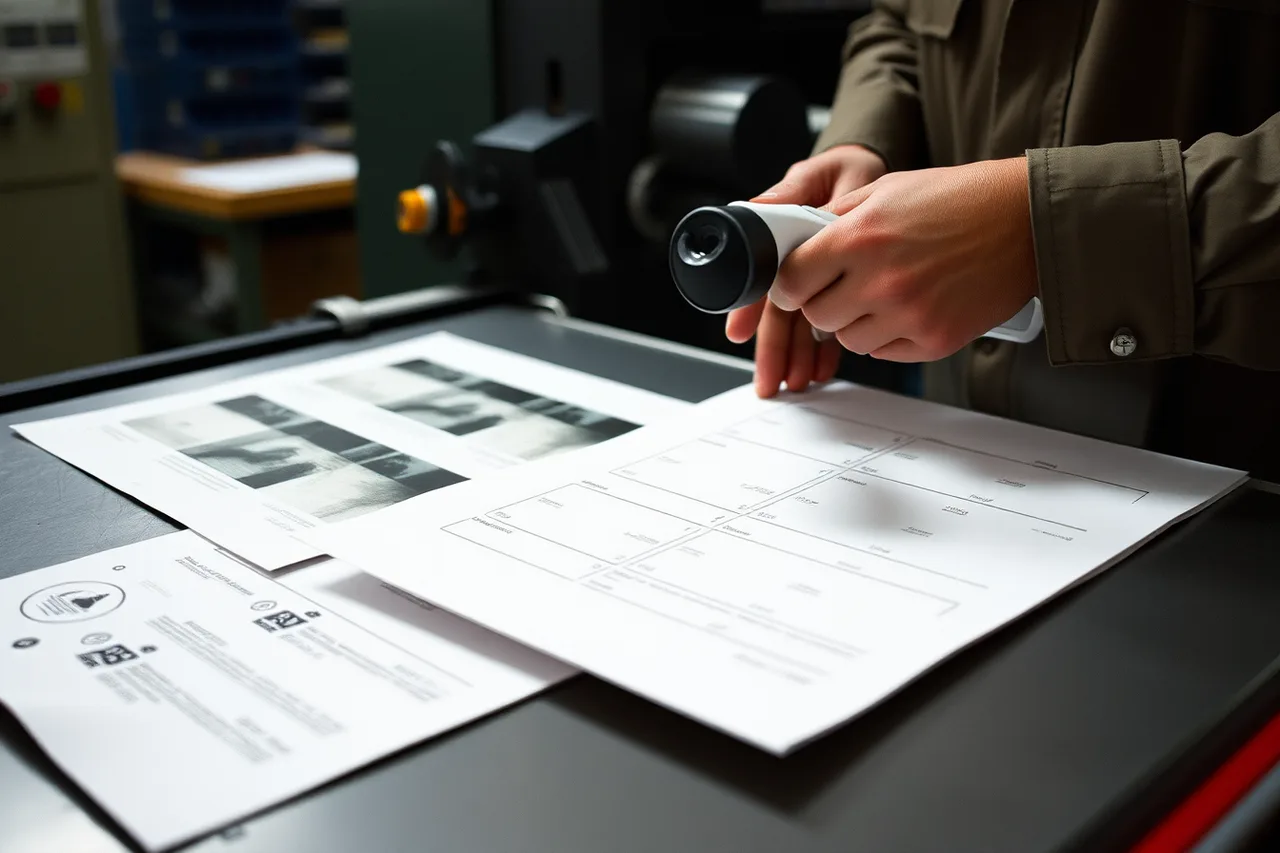
Physical proof is where print trends fail
Digital preflight passes a file that still prints wrong. A mailpiece barcode can pass preflight as clean vector art and still fail a USPS barcode readability test once ink spreads on the sheet. USPS measures that on the printed piece, not on the file.
The QR code specification (ISO/IEC 18004) sets a four-module quiet zone. Place that zone near the trim and a cutter drift can clip it, so the code stops scanning. Both faults clear digital preflight and both surface only at the press or after the drop.
- Start with a documented reader problem
- Use the smallest reversible placement
- Keep claims and rights tied to the exact version
- Test the exported file and the physical proof
- Monitor destinations, fulfillment, and corrections
- Measure mature effect, complete cost, complaints, and waste
How short runs and variable print are priced
Unit price falls as quantity rises. Digital printing carries low setup and a high cost per sheet; offset carries high setup and a low cost per sheet. A typical planning band puts digital below roughly 1,000 to 2,000 pieces and offset above.
The crossover depends on the shop, the paper, the page count, and the finishing. Ask for quotes at 500, 1,000, and 2,500 pieces; the delta per piece is the number to sign off on.
Variable print adds a per-piece data fee and often a minimum order. A 500-piece variable run can cost more per piece than a 500-piece static run, because the merge scales with records, not sheets. Postage is often the largest single line on a mailed campaign, so ask for print and postage together.
AI imagery needs a rights and provenance record
NIST's Generative AI Profile lists generative-AI risks and suggested actions as a cross-sector companion to its voluntary AI framework. The profile is NIST AI 600-1, published in July 2024. It approves no advertising tool and no output.
Pick controls for the actual people, data, claim, media, and consequence in front of you. NIST is a US federal agency, and its AI publications are voluntary frameworks, not US regulations.
Content credentials can carry provenance data with a file. They do not prove an image is truthful, licensed, accessible, or fit to print. Check those separately, then confirm the record survives your real workflow from concept to press.
A QR code is a privacy decision
The W3C Privacy Principles statement gives web-system designers shared privacy concepts and warns against shifting privacy work onto individuals. A printed QR code that opens a tracking page inherits that duty.
W3C is an international standards body. Its principles are voluntary guidance, not law in the United States or Canada.
Decide what the destination collects before the piece goes to press, because a reprint to fix a landing page costs more than the landing page did.
Pew Research Center reported in 2024 that about nine in ten US adults own a smartphone. Scan rates depend on placement, offer, audience, and the landing page.
Maintain a dated watchlist
Label each item shipped, limited release, preview, announced, or inferred. Name the affected workflow, source, owner, test, and rollback condition. Recheck the primary page before publication and again before adoption.
The NIST AI RMF Playbook offers voluntary AI-risk actions under govern, map, measure, and manage. It is not a product ranking or a forecast. Keep the evidence record beside the decision, set the next review date, and name the change that would trigger an earlier check.
Common questions
Will AI replace print designers?
AI can assist bounded tasks. Accountable people still control these areas:
- facts
- rights
- accessibility
- production
- review
- correction The designer's job shifts toward approving and defending those decisions.
Do content credentials prove an image is real?
No. They may carry provenance data with the file. Truth, completeness, rights, and context still need a separate review before the image goes on a page.
Which print trend should a small business test first?
A QR code on one existing piece costs less to produce than a variable-data run, because it skips the merge. Price both before you choose.