Costs
Part of A complete guide to direct mail marketing for 2027 campaigns
A direct mail marketing checklist for teams that hate surprises
direct mail marketing checklist covers purpose, audience, data, offer, claims, format, production, postal review, response, fulfillment, measurement, and closure.
What to take away
- A checklist supports judgment but does not replace it.
- Review the physical item, merged data, and response path together.
- Release authority should remain with one accountable owner.
A direct mail marketing checklist should follow the campaign from decision through closure. Adapt the controls to the format, postal service, audience, product, jurisdiction, data sensitivity, vendor model, and consequence of error.
Strategy and audience
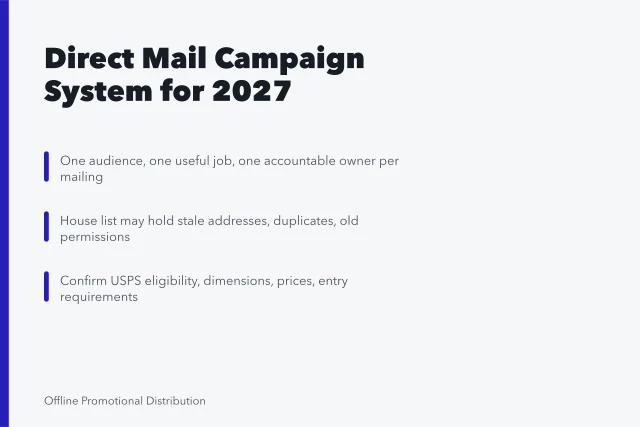
- Name the customer need, campaign job, mature outcome, and owner
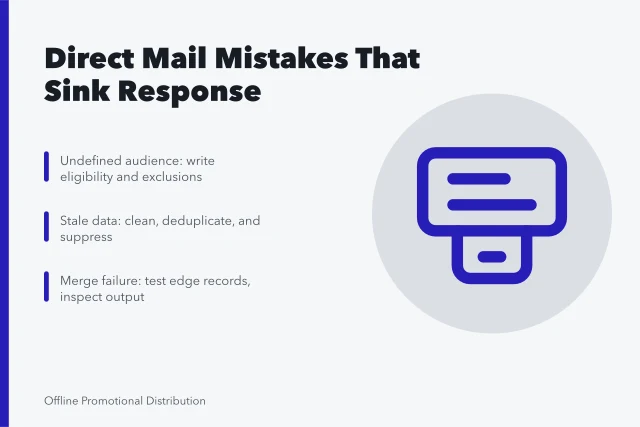
- Define geography, eligibility, exclusions, list source, and data date
- Record capacity, budget, timing, comparison, and stop conditions
- Apply opt-outs, complaints, recent-purchase rules, and duplicate logic
Offer and physical proof
| Checkpoint | Pass evidence |
|---|---|
| Claims | Current source, reviewer, scope, and effective date |
| Terms | Price, eligibility, deadline, limits, and exclusions are noticeable |
| Format | Final size, stock, folds, seals, and finish are approved |
| Personalization | Normal and edge records render correctly |
| Response | Phone, URL, code, form, and alternative route work |
| Accessibility | Readable hierarchy and supported alternative are available |
USPS Every Door Direct Mail Retail requires at least 200 pieces per ZIP Code and no more than 5,000 pieces per day per ZIP Code. Each piece must be at least 6.125 by 11.5 inches and at least 0.007 inch thick.
Postage follows the current Marketing Mail retail rate for those ZIP Codes, so price it from the current notice, not a fixed figure. Check the fact sheet before the mail date, because forms and entry procedures change.
Canada Post Neighbourhood Mail is the closest Canadian equivalent and carries its own size, quantity, and addressing rules for that market.
Production and release
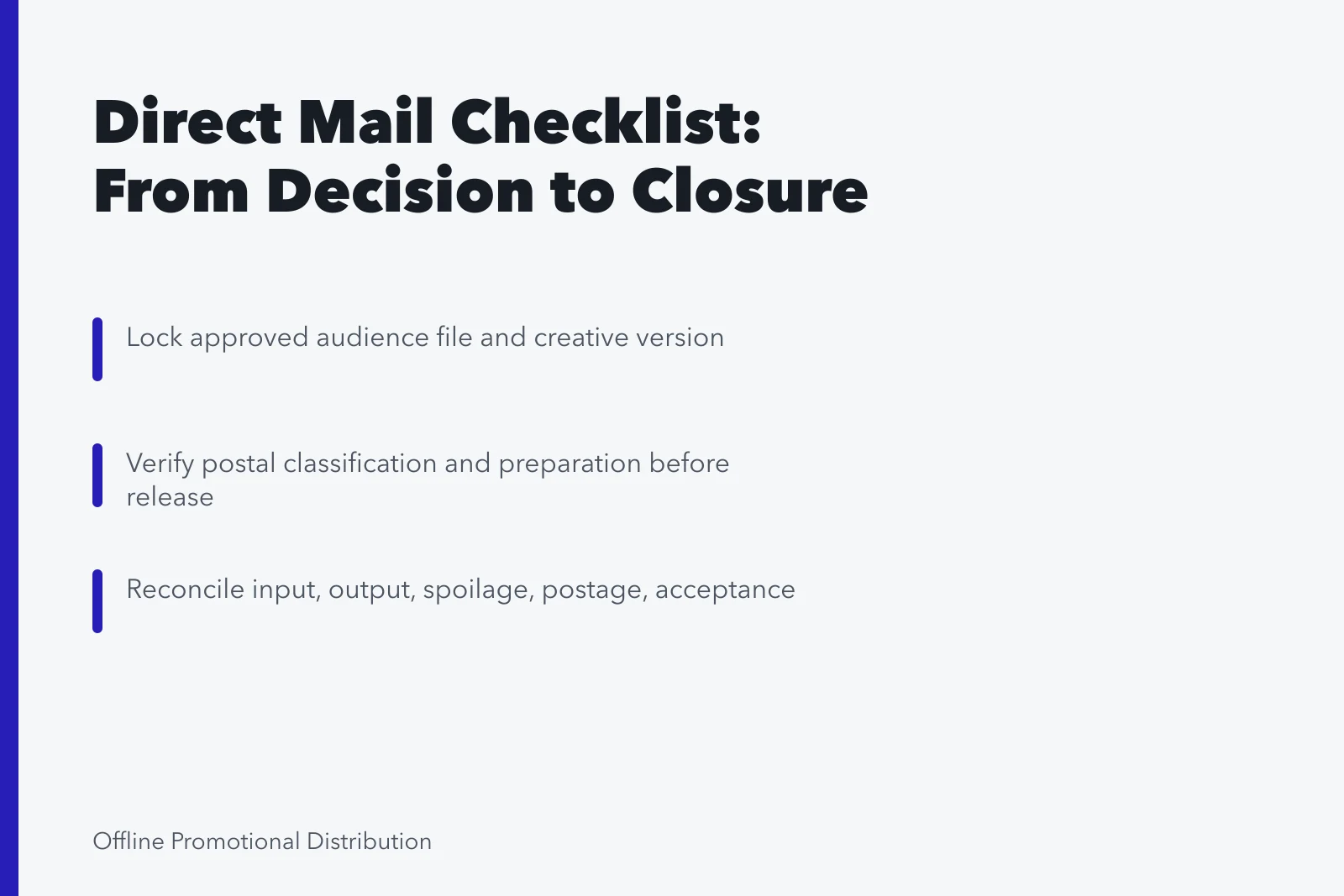
- Lock the approved audience file and creative version
- Use secure transfer and named vendor accounts
- Verify postal classification and preparation
- Inspect samples across the full run
- Reconcile input, output, spoilage, postage, and acceptance
- Confirm response staffing, inventory, correction, and incident routes
For connected mail, USPS Informed Delivery asks for a campaign image of at least 300 by 200 pixels, under 200 KB, in JPG, PNG, or GIF. Technical acceptance does not establish accessibility, claim support, customer suitability, or campaign effectiveness.
Production and Release Steps
- Lock approved audience file and creative version
- Use secure transfer and named vendor accounts
- Verify postal classification and preparation
- Inspect samples across the full run
- Reconcile input, output, spoilage, postage, acceptance
- Confirm response staffing, inventory, correction, incident routes
Measurement and closure
- Preserve assignment and holdout records
- Monitor nondelivery, responses, complaints, and service pressure
- Wait for completed outcomes, cancellations, and returns
- Reconcile complete costs and report uncertainty
- Update suppression records and close vendor access
- Destroy obsolete stock and archive the decision
Attach each completed checkpoint to evidence, an owner, and a date. Carry unresolved exceptions into the release decision instead of hiding them in notes.
Record the gate result
The W3C Privacy Principles statement is written for web systems, so treat it as background rather than a mail rule.
The privacy checks that decide a mail release are narrower. They cover the notice text, the suppression file version and load date, the opt-out honored against the exact mailed list, and who may open the address file. Record the law you applied and who answers a complaint.
The CISA software acquisition fact sheet covers acquisition risk, not print vendors, so borrow its questions rather than its conclusions.
Vendor checks for a mail file: encrypted transfer, named accounts only, a deletion date after print, a current confidentiality agreement, and evidence the merge ran on the locked list.
For every checklist item, record pass, fail, not applicable, or accepted exception. Add the evidence location, reviewer, decision date, and next review. A checked box without proof cannot protect a release. Stop the work when a mandatory privacy, security, data-quality, accessibility, or correction condition fails, even if the remaining score looks favorable.
Keep the evidence record beside the decision so a reviewer can reproduce the reasoning. Set the next review date and name the change that would trigger an earlier check.
An example of a closed gate record:
| Gate item | Result | Evidence | Owner | Date |
|---|---|---|---|---|
| Suppression file loaded | Pass | suppression_2025-03-04.csv, hash 9C1E, load log line 44 | Data lead | 2025-03-04 |
| Informed Delivery image | Fail, fixed | 280 by 200 px rejected, resubmitted at 300 by 200 | Mail coordinator | 2025-03-07 |
Record rejected options and the chosen path, since the original constraint may later change.
Printable checklist
Print this page and tick each line.
- Need, job, outcome, owner
- Geography, eligibility, exclusions, data date
- Opt-outs and duplicates applied
- Claims, terms, format approved
- Personalization on normal and edge records
- Phone, URL, code, form tested
- Audience file locked, transfer secured
- Postal preparation verified, samples inspected
- Counts, spoilage, postage reconciled
- Response staffing and incidents confirmed
- Costs reconciled, suppression updated, access closed
- Stock destroyed, decision archived
Common questions
When should this checklist be signed?
Record named approvals before data release, production, postal entry, and any material change.
Does a printer proof complete review?
No. The team must also inspect data, claims, response, fulfillment, postal preparation, and measurement.
What should be archived?
Keep the approved version, source facts, counts, postal evidence, results, costs, incidents, corrections, and decision under the retention policy.