Strategy
Part of Offline marketing strategy: the choices that shape everything else
Offline marketing strategy benchmarks with the caveats attached
offline marketing strategy benchmarks in 2027 require units, geography, delivery, response, fulfillment, full cost, comparison design, raw counts, and uncertainty.
What to take away
- Build an internal baseline before adopting an external target.
- Separate produced, distributed, noticed, responded, and fulfilled units.
- Report uncertainty and operational failures beside response rates.
Offline marketing strategy benchmarks in 2027 are only comparable when the unit and delivery chain are explicit. A response rate can use pieces mailed, pieces delivered, households reached, calls received, codes redeemed, qualified inquiries, or mature customers as its denominator.
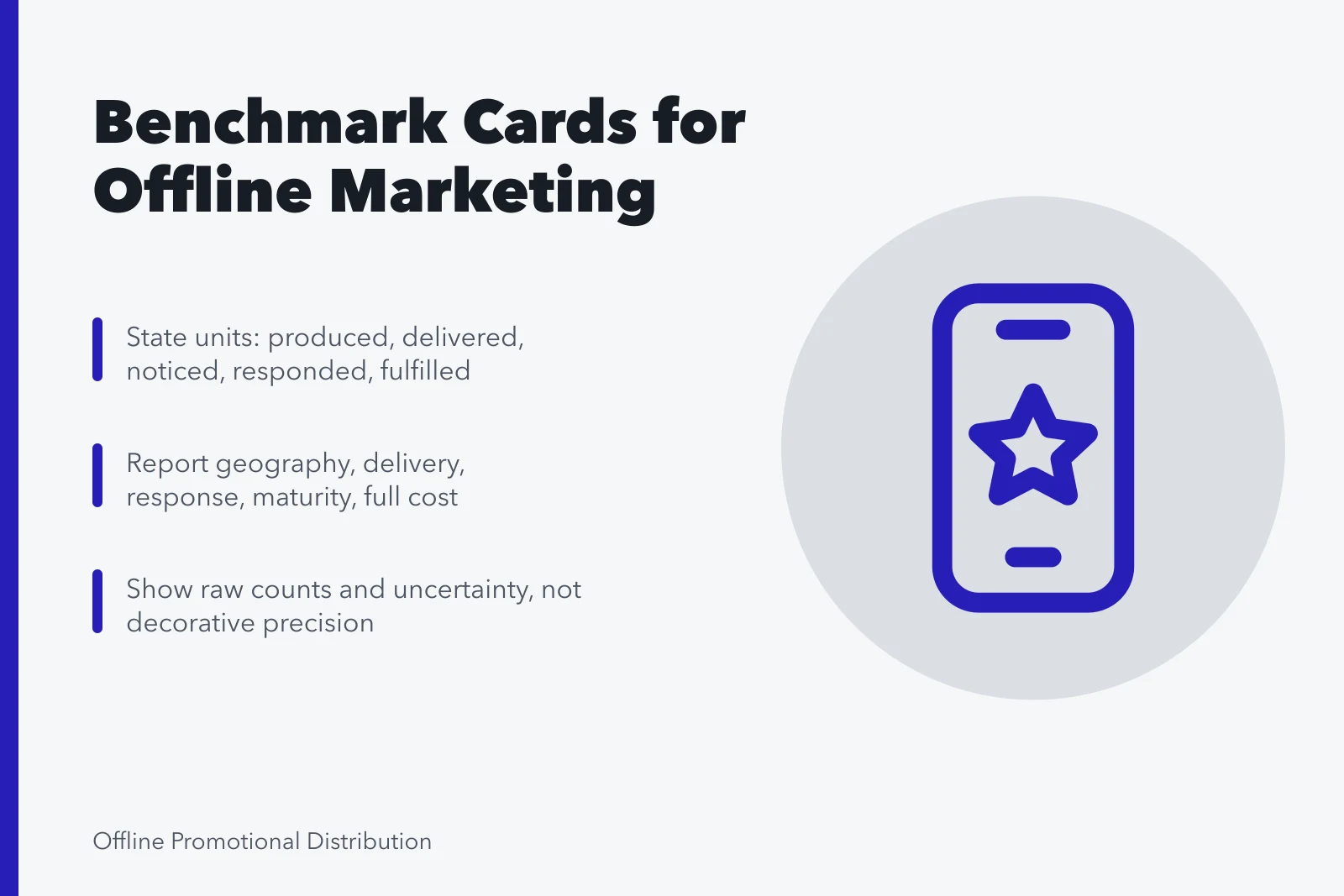
Publish a benchmark card
| Field | Required statement |
|---|---|
| Audience | Eligible people or businesses and exclusions |
| Geography | Postal areas, venues, stores, or placements |
| Delivery | Produced, accepted, installed, returned, or removed |
| Response | Call, scan, visit, inquiry, redemption, or order |
| Maturity | Cancellation, return, and fulfillment window |
| Economics | Complete campaign and operating cost |
The UK government's Magenta Book provides public-sector guidance on evaluating policies, projects, and programs. It is not an advertising benchmark manual, but its emphasis on evaluation design, proportionality, and evidence can improve a campaign measurement plan.
Show estimation limits
The NIST engineering statistics handbook explains confidence intervals for a proportion under stated assumptions. Campaign samples, clusters, geography, repeated customers, and imperfect delivery can require different methods. Use qualified analysis and publish assumptions instead of decorative precision.
- Delivery and undeliverable rate
- Qualified response per delivered unit
- Mature outcome per eligible audience
- Incremental outcome against comparison
- Cost per qualified and mature outcome
- Complaint, waste, service, and accessibility failures
Compare like campaigns under stable definitions. Annotate weather, construction, holidays, competitor activity, inventory, staffing, price, placement, vendor changes, and tracking faults. Report raw counts with rates and do not project a complete window from early responders.
External figures can frame a question, but archive their source, method, date, sample, geography, format, and commercial relationship. Reject a target that cannot be made comparable enough for the decision. Poor targeting and hidden terms are among the offline marketing strategy mistakes that bad external figures tend to hide.
Set separate thresholds for data quality and business performance. A campaign should pause when delivery records, response routing, inventory, or staff coverage fail, even if early response looks strong. Resume only after the cause and affected period are documented.
Publish revised baselines and corrections when definitions, geography, vendors, response systems, or fulfillment rules change materially.
Make the comparison reproducible
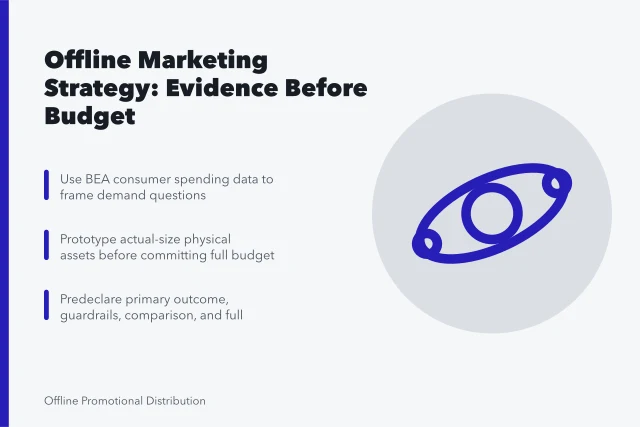
The GAO evaluation design guide connects evaluation questions with evidence needs and design choices. Apply that discipline to offline marketing strategy benchmarks; federal evaluation guidance does not make a local marketing result causal or transferable.
The NIST experimental design selection guidance begins design choice with the objective and practical constraints. It supports separating offline marketing strategy benchmarks reporting from controlled effect estimates, not turning observation into causation.
State the benchmark population, period, inclusion rules, calculation, and currency. Add maturity window and uncertainty before comparing results. Keep market context separate from an internal target. Recalculate from the cited source or governed dataset, then record any mismatch.
A benchmark becomes useful only after the local team explains why the comparison group and method fit the decision. A benchmark card is only as good as the offline marketing strategy checklist behind its recorded definitions.
For offline marketing strategy benchmarks, keep the evidence record beside the decision so reviewers can reproduce the reasoning without memory. Set the next review date and name the change that triggers an earlier check.
Log rejected options and the chosen path because the original constraint may change. Use the same definitions in the interface, export, meeting note, and correction log, and close unused reports and permissions when the decision cycle ends.
Common questions
What is a good response rate?
There is no universal rate; channel, audience, offer, delivery, definition, and maturity differ.
Should cost per scan be reported?
It may diagnose response, but use a qualified or mature outcome for investment decisions.
How should small samples be handled?
Show counts and appropriate uncertainty, and avoid claims that exceed the design and evidence.