Rules
Part of Offline marketing strategy: the choices that shape everything else
3 things an offline marketing strategy checklist has to cover
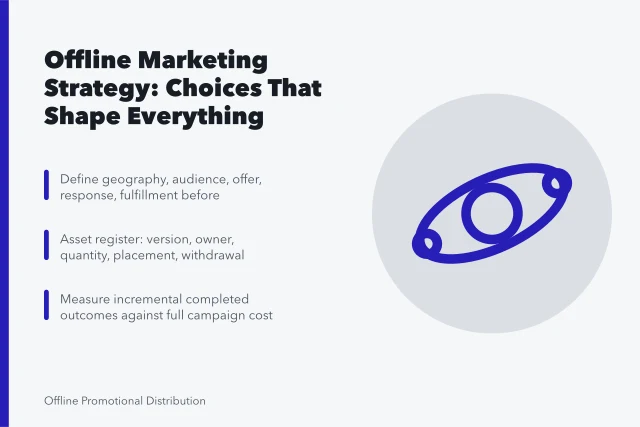
An offline marketing strategy checklist covers three areas of the physical mail piece, the landing spot, and the response tracking proof it worked.
What to take away
- An offline marketing strategy checklist has to cover three things: the piece, the placement, and the proof. Those three decide whether a print, mail or outdoor campaign works.
- Canada Post Neighbourhood Mail reaches every address on a route; Personalized Mail carries a name and address and costs more per piece.
- A printer proof is not a field test. Walk the route, open the mailer, scan the code, call the number.
- Every claim on the piece needs its evidence and its owner recorded before release.
- Budget the campaign by province or state, because postage, tax and language rules change at the border.
The three areas
An offline marketing strategy checklist gets long fast. Three things carry the weight: the piece, the placement, and the proof. Name one owner for each area before the first draft.
1. The piece
The piece is what the customer holds. It has to survive the trip and answer the offer in one read.
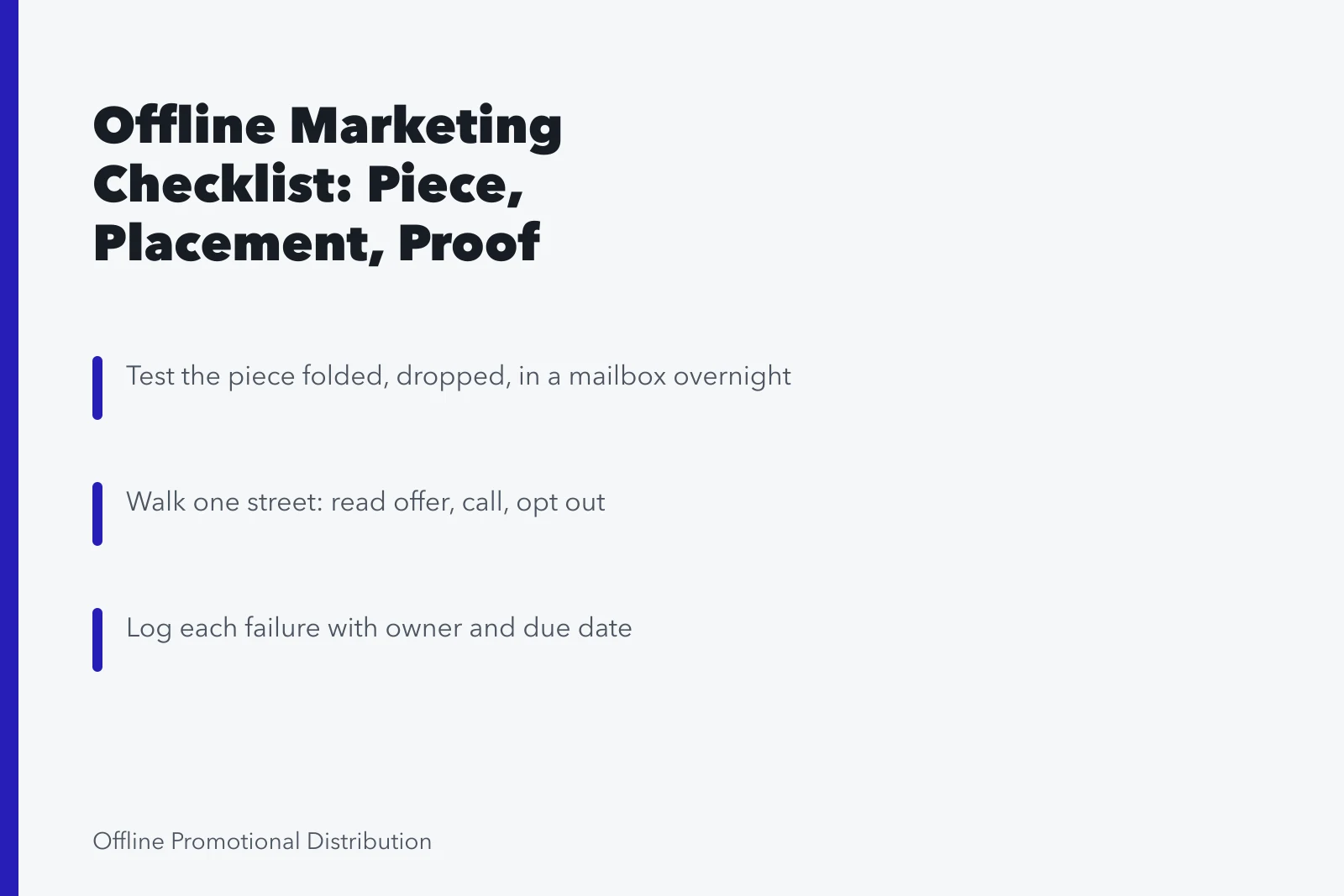
Check the physical build under real conditions. Fold it, drop it, leave it in a mailbox overnight. Confirm type size, contrast and ink coverage on the actual stock, not on a screen.
Name the offer, the price, the dates and the response path in plain words. A Canada Post Personalized Mail envelope, a USPS Every Door Direct Mail flat and a door hanger each cap how much you can say at a readable size.
The U.S. Department of Justice explains effective communication under the ADA and covers auxiliary aids and services in covered settings. Its 2024 rule for state and local governments points to WCAG 2.1 Level AA for the web and app pages a mail piece links to.
Obligations depend on the entity and the circumstances. Have a qualified reviewer look at the physical piece and the response route together.
2. The placement
Placement is where the piece lands and who handles it. Most offline campaigns lose money here.
Canada Post splits distribution two ways. Neighbourhood Mail goes to every address on a route and needs no list. Personalized Mail carries a name and address, so it needs a clean list and costs more per piece. Pull the figure for your weight and volume before you commit.
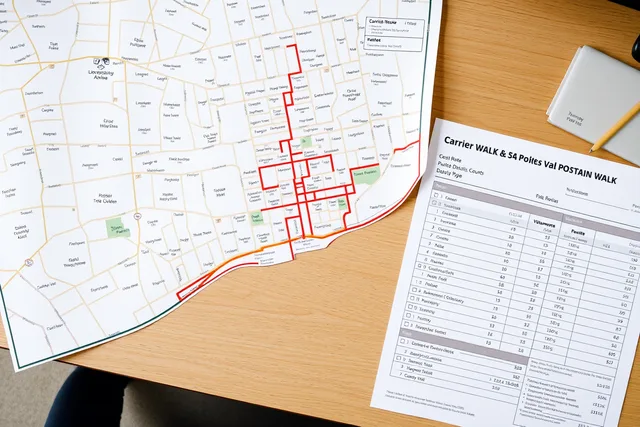
USPS Every Door Direct Mail Retail does the same job south of the border. You pick carrier routes on a map and pay retail postage per flat, with no mailing list at all. USPS Marketing Mail needs a list and an automation barcode, and typically costs less per piece at volume.
Quebec adds a step. The OQLF enforces the Charter of the French Language on commercial signage, packaging and published material. Rules differ by medium and by business size. Confirm your French creative with the OQLF and a qualified Quebec lawyer or notary before you print.
| Review | Evidence to hold |
|---|---|
| List or lead source | Purpose, permission, fields, date, suppression |
| Vendor | Scope, access, quality, incident and deletion terms |
| Response path | Tested code, URL, phone, form, fallback |
| Carrier scan data | IMb record or proof of mailing, delivery dates, exceptions |
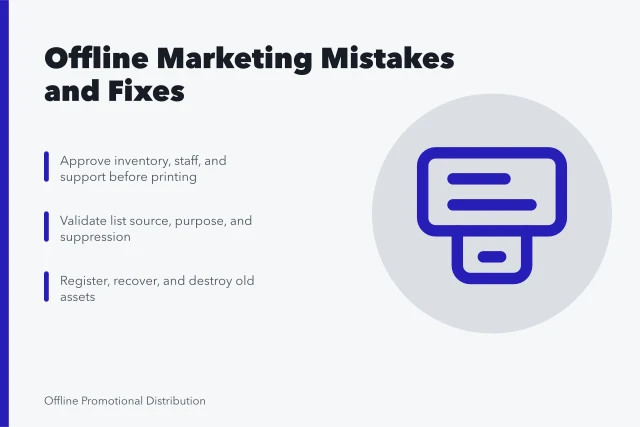
| Assets | Version, quantity, placement, recovery, disposal |
NIST's small business cybersecurity resources cover identifying, protecting, detecting, responding and recovering from cyber risk. A paper campaign still exposes lead forms, QR destinations, shared devices and vendor portals.
3. The proof
Proof is the record that the campaign did what you paid for. Set it up before launch, not after.
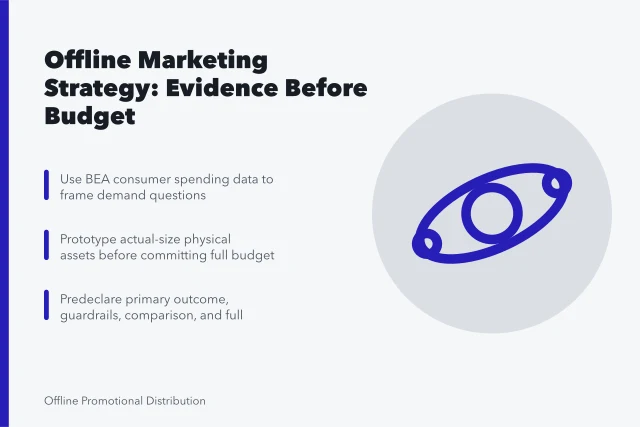
Offline campaign measurement in 2027 needs a defined exposure, a defined outcome and a privacy guardrail before any physical tactic goes live. The W3C Privacy Principles statement gives designers shared privacy concepts and warns against shifting that work onto individuals.
Reconcile invoices, quantities and delivery records against the approved asset register. Do the same for placement dates, recovered stock and destruction evidence. Record pass, fail, not applicable or accepted exception for each item, with the evidence location, reviewer and date.
Ask the carrier what scan data it holds. The USPS Intelligent Mail barcode returns piece-level delivery scans when the mailer uses one. Canada Post Personalized Mail gives a proof of mailing and checks the address list against its database before the run.
The CISA software acquisition fact sheet covers development practice, supply-chain exposure, deployment and vulnerability management. Those questions belong in a vendor review, not a local approval.
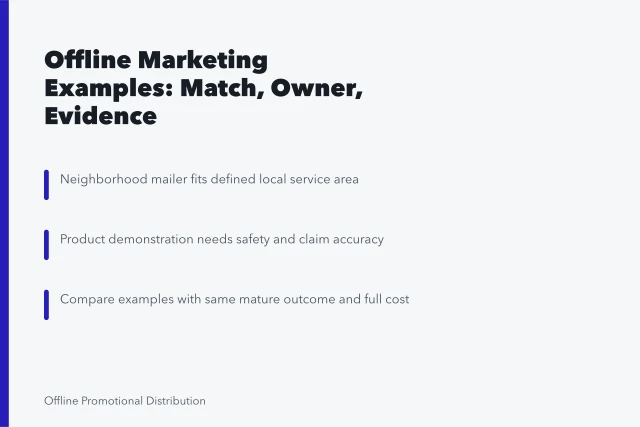
Worked example: walking the route
Pick one street. Walk it as a customer would.

Find the piece. Read the offer. Use the alternative format. Call the number. Complete the response. Ask for a correction or an opt-out. Repeat after hours, in rain, with the piece folded the way the mail carrier folds it.
Log every failure with its severity, a temporary safeguard, an owner and a due date. Do not release the full run until each one is closed. The offline marketing strategy mistakes that sink campaigns usually show up on this walk, not in the proof.
Common questions
Who signs the checklist?
The business owner, plus whoever owns creative, operations, data, vendors and measurement. One name per area, not a committee.
When does it get reopened?
After any change to the offer, the piece, the route or the vendor. The response path and the law count too. Set a review date and name the trigger that moves it earlier.
Does a printer proof complete the review?
No. A proof shows the ink is right. It says nothing about how the piece survives a mailbox, a doorstep or a front desk.
How do I cost this by province or state?
Build the arithmetic in named variables: pieces times unit postage, plus production, plus list cost, plus tax treatment. Canada Post publishes a rate card and updates it each January. USPS Marketing Mail automation letters typically run in the low tens of cents per piece, while Every Door Direct Mail Retail bills at the retail flat rate.
Quebec adds QST at 9.975% and the rest of Canada adds GST at 5%. Postage rates come from Canada Post, tax treatment from the Canada Revenue Agency or Revenu Quebec, and both change. Confirm with a CPA before you sign the purchase order.