Reviews
Part of Offline marketing strategy: the choices that shape everything else
Offline marketing strategy tools through the eyes of a daily user
offline marketing strategy tools for 2027 should support market research, asset control, lists, maps, response routes, checks, cost records, and evidence exports.
What to take away
- A tool should support a defined decision or control.
- Public data tools need definition, timing, and geography checks.
- Test export, correction, and shutdown before depending on software.
- Match the job to a named product: QGIS for maps, Airtable for asset registers, Zoho CRM for follow-up, CallRail for call tracking, KoboToolbox for field forms.
Offline marketing strategy tools cover market research, geographic planning, address quality, asset control, and project workflow. They also cover response routing, field inspection, surveys, and experiments. Finance and reporting round out the list. A daily user picks by job, not by category label, and judges each product on tasks done from a phone in the field.
Test a public market-research tool
The U.S. Bureau of Economic Analysis provides Interactive Data tables for accessing and working with economic statistics. A public table has its own concepts, release timing, revisions, and geographic limits. Use it to frame a market question, then verify local conditions through field and operating evidence.
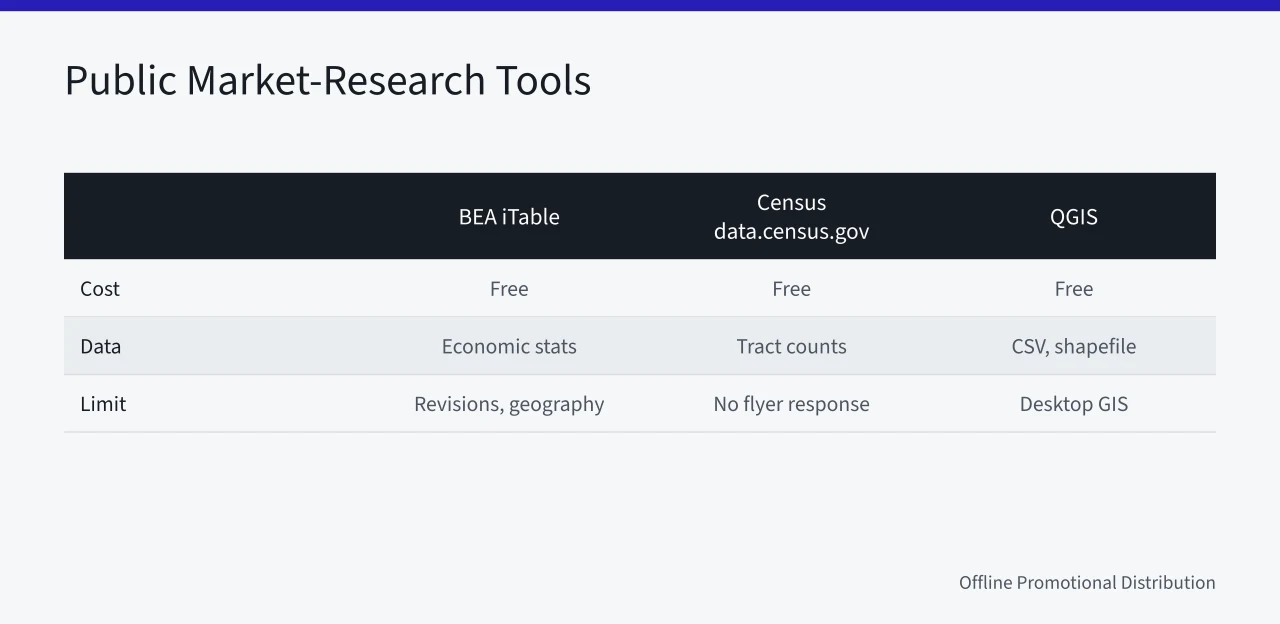
The Census Bureau's data.census.gov gives free tract-level counts for population, income, and housing. Both sources cost nothing to use. Neither one measures local response to a flyer, so pair the numbers with door counts or list quality checks.
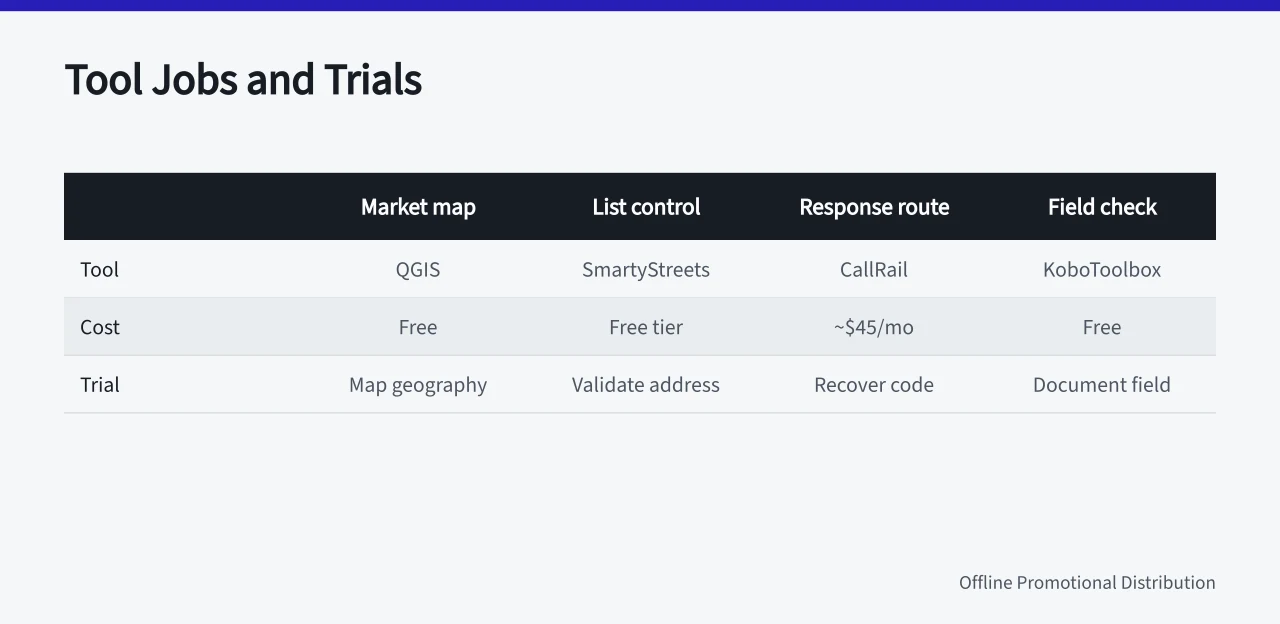
| Tool job | Trial | Named tool and public fact |
|---|---|---|
| Market map | Find and explain one target geography | QGIS is free, open-source desktop GIS that reads CSV and shapefile data |
| Asset register | Trace one proof through placement and removal | Airtable has a free tier; Team plans typically around $20 per seat per month billed annually |
| List control | Apply correction and suppression | SmartyStreets validates US addresses with a small free tier and pay-as-you-go pricing |
| Response route | Recover from broken code or phone path | CallRail call tracking plans typically start around $45 a month |
| Field check | Document location, time, condition, and version | KoboToolbox is free and open source, with offline forms for Android |
| Measurement | Reproduce one mature outcome and full cost | QuickBooks Online Simple Start typically lists near $30 to $35 a month |
Use trend data carefully
Google's explanation of Google Trends data describes a normalized sample of Google searches and notes that it is not a scientific poll. It can help frame timing or regional research questions, but it does not measure offline exposure, total demand, or campaign causation.
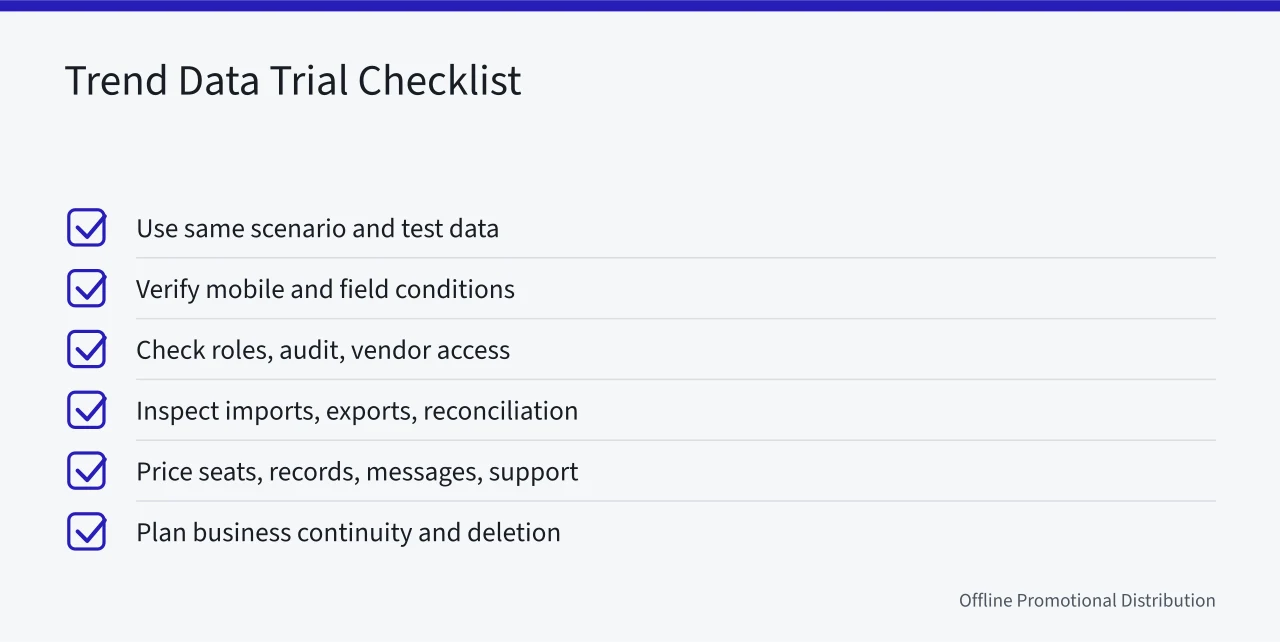
- Use the same scenario and test data for finalists
- Verify mobile and field conditions
- Check roles, audit history, and vendor access
- Inspect definitions, imports, exports, and reconciliation
- Price seats and records, then price messages, maps, storage, and support
- Plan business continuity and deletion
Bitly shortens links and counts clicks free on its basic tier, with paid plans typically under $10 a month. Twilio publishes per-message rates, and US SMS typically runs under a cent per message plus carrier fees. Both matter when a postcard, poster, or door hanger carries a code.
A paper checklist may outperform software for a small, infrequent campaign. Add technology only when it reduces a verified burden without weakening customer control, evidence, accessibility, or ownership.
Run the trial on a phone and at the campaign location. Import a corrected list, remove a vendor user, replace a destination, and record a field exception. Reconcile a mature outcome, export the evidence, and close the campaign. Time each task and note every manual workaround, hidden limit, permission gap, and support dependency before buying.
Have the future daily operator approve the completed trial record.
Test the operating burden of CRM, workflow, and finance tools
The GOV.UK technology selection guidance recommends adaptable choices, data control, security review, and ownership-cost analysis. Use those public-service questions when assessing offline marketing strategy tools; they are not product endorsements.
HubSpot's free CRM tier carries no per-seat charge for core contact records, and paid Sales Hub seats typically list near $20 per seat per month. Zoho CRM is free for up to three users, with Standard seats typically around $14 per user per month billed annually.
Asana gives free project boards for up to 10 people. Wave provides free accounting for small businesses, and QuickBooks Online Simple Start typically lists near $30 to $35 a month.
The GOV.UK open standards guidance links open standards with interoperability and reduced supplier dependence. Test whether offline marketing strategy tools data and definitions can move, while keeping the page's UK public-service context clear. The same interoperability test applies to common offline marketing strategy questions about audiences, channels, and budgets.
Give each tool the same source sample, user roles, required output, failure case, and export task. Measure setup time, recurring labor, specialist help, correction work, and shutdown effort.
Credit applies only when an intended user completes the task safely. Save the tested plan and date because a current product page does not promise the same function or price in 2027.
For offline marketing strategy tools, keep the evidence record beside the decision so a reviewer can reproduce the reasoning without memory. Set the next review date and name the change that would trigger an earlier check.
Record rejected options as well as the chosen path because the original constraint may later change. Use the same definitions in the interface, export, meeting note, and correction log. Close unused reports and permissions after the decision cycle ends.
Common questions
Do offline campaigns need a CRM?
Only when the customer and sales workflow requires one and the team can govern data, access, and follow-up. Zoho CRM's free plan covers up to three users, which is enough to test the workflow before paying.
Are mapping tools enough for site selection?
No. Combine source definitions with observation, accessibility, permits, operations, and customer research. QGIS can hold the map layer and still miss a blocked entrance or a permit limit.
What is the key buying test?
A real operator can complete normal, failure, correction, export, and shutdown tasks safely.
Which offline marketing tools have free tiers worth testing?
QGIS for maps, KoboToolbox for field forms, and Wave for accounting cost nothing. Zoho CRM is free for up to three users, and Bitly's basic link shortening is free.