Careers
Part of Offline marketing strategy: the choices that shape everything else
The honest guide to offline marketing strategy trends, updated for 2027
QR codes, tamper checks, printer proofs and local radio buys now decide whether offline marketing campaigns survive contact with real customers in 2027.
What to take away
- Five trends carry into 2027QR-first print, out-of-home bought on measured cost per placement, renegotiated event space, compliance-first promotional sourcing, and AI-assisted creative under a written risk process.
- Give every trend an evidence label, a named owner, a review date and a rollback condition before money moves.
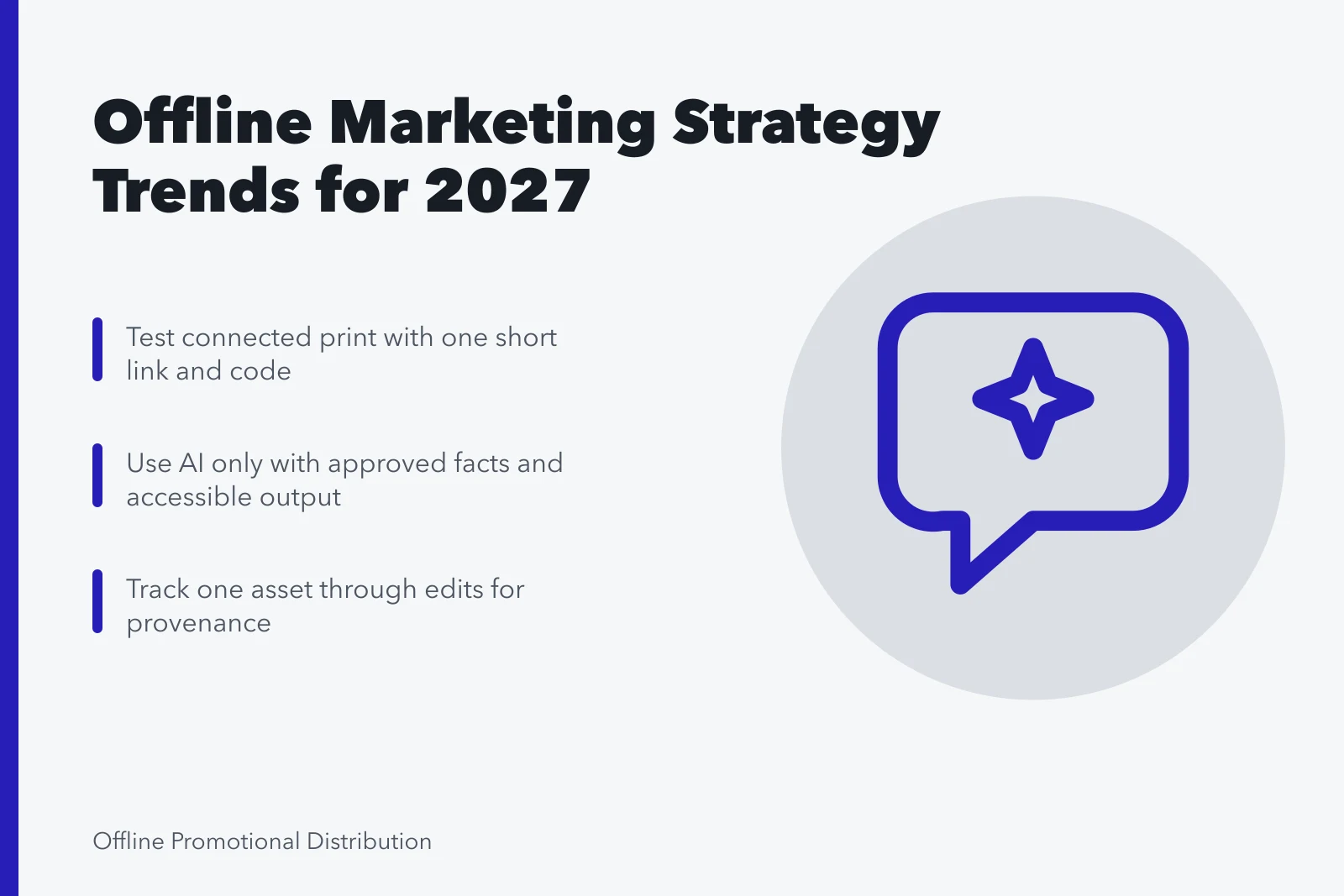
- Test the smallest reversible version first. Secure the code and audit placements before you spend on creative.
- A trend with no primary source and no date is a planning assumption, not a fact you can budget against.
The 2027 trend list at a glance
Start here. The table below is the short answer to what matters, who owns it and how you get out.
2027 trend list at a glance
| Trend for 2027 | Evidence label | Owner | Review date | Rollback condition |
|---|---|---|---|---|
| QR-first print with tracked destinations | Shipped | Campaign lead | 90 days | Redirect off, printed URL stays readable |
| Out-of-home placed on measured cost per placement | Shipped | Media buyer | 6 months | Move budget to local print and sponsorship |
| Event and trade show space renegotiated | Shipped | Events lead | Contract renewal | Drop one booth, keep one field day |
| Compliance-first sourcing of promotional goods | Shipped | Procurement | 12 months | Hold the SKU, switch supplier |
| AI-assisted creative under a written risk process | Limited release | Creative director | Quarterly | Files return to the studio |
Use five labels: shipped, limited release, preview, announced, inferred. A shipped item exists in a live product today. A limited release is in testing with named users. Anything weaker supports a watchlist entry only, never a budget line.
The offline marketing strategy guide sets channel roles before trend money is committed, and that order matters more than the trend itself.
Trend 1: QR-first print with tracked destinations
Printed pieces now carry the measurement layer. A unique tagged URL per placement turns a poster or a mailer into a countable channel. Google's Campaign URL Builder documents the UTM parameters that separate a transit shelter scan from a lobby poster scan (Google Analytics Campaign URL Builder).
Keep the code on a domain the customer recognizes, and print the destination in words beside it. Never route a scan straight into a payment, login or account change. The Federal Trade Commission has warned about codes that hide harmful links, and a paid placement deserves the same suspicion as a sticker on a parking meter.
Secure the QR code
- Destination domain owned by business
- Printed context names the destination
- Typed URL or phone alternative
- Redirect and certificate monitoring live
- Takedown scheduled at campaign end
Assign one person to inspect placements on a set schedule and photograph each one. Codes get covered, swapped or scraped off community boards. A tampered code that stays up for a week costs more than the inspection does.
A scan is not a sale. Tie scan volume to leads or orders with the offline campaign measurement method, or you will report activity and call it demand.
A trend earns budget only when a primary source, a date and a rollback condition sit in the same note.
Trend 2: Out-of-home and events bought on measured cost
Billboard and out-of-home prices move with location, format size and market, so a state-by-state comparison needs your own quotes rather than a national average (outdoor advertising). Ask for cost per thousand impressions and the proof-of-play report in the same request.
Trade show space is usually sold per square foot, and the Wikipedia overview of trade shows covers booth rental and the costs that sit around it (trade shows). Add drayage, electrical, staffing and lead capture before you approve the floor plan.
In Canada, compare a chamber membership against a single local sponsorship using the same measurement. The Halifax cost per lead comparison walks through both and shows which one reports a number you can defend.
Trend 3: Compliance-first sourcing of promotional goods
Promotional products are regulated goods, not giveaways. Children's items distributed in the United States fall under testing and certification rules in 16 CFR Part 1107, and Canada adds the Canada Consumer Product Safety Act on top. Quebec adds French-language commercial advertising rules inside the province.
For 2027, procurement is the trend to watch. Ask for test certificates and recall history before you approve artwork, not after the run lands.
How to test a trend before you commit the year
How to test a trend
- Write the claim in one sentence with a source URL and the date you read it.
- Label the evidenceshipped, limited release, preview, announced or inferred.
- Name the owner, the review date and the budget cap.
- Set the rollback condition in writing before launch.
- Run the smallest reversible version, then read it against offline marketing strategy benchmarks with their caveats attached.
Keep two items live and park the rest. A team watching five trends at once finishes none of them, and a parked list is cheaper to restart than a half-built campaign.