Strategy
Offline promotional distribution for US small business: a 2027 planning guide
A four stage workflow for US small businesses: channel mapping, local cost drivers, a pre-print checklist, and freight handoff with tracked response paths.
What to take away
- Offline promotional distribution runs in four stageschannel selection, local cost pricing, a written checklist, and a controlled handoff to freight.
- Cost drivers are channel specific. Booth space rents by the square foot, insert rates follow circulation, and outdoor pricing follows placement and market size.
- Every channel needs a measurable response path, and a QR code pointing at a unique URL counts scans without a call center.
- Consumer protection rules cover the offer and the item, so claim and safety checks happen before the print run starts.
Map the offline marketing distribution channels
Start by listing every physical touchpoint your customer already passes. For a US small business that usually means direct mail, newspaper inserts, in store signage, event sampling, sponsorships, trade shows, and outdoor boards.
Each channel carries its own minimum spend and lead time. Print inserts need a circulation commitment. Sponsorships need a season. Trade shows need booth space booked months ahead.
Write the list before you price anything. A channel you cannot staff should not appear on it.
Wider coverage of these options sits on our offline promotional distribution home page.
Build a promotional distribution strategy around audience, offer, and route
A promotional distribution strategy answers three questions in order. Who receives the piece. What the piece asks them to do. How it physically arrives.
The audience decides the route. Household addresses point to mail and door hangers. Registered attendees point to trade shows. Local business owners point to chamber sponsorships and local event programs.
The offer decides the format. A coupon needs a scannable surface. A sample needs a box. A product demo needs a booth and a trained person standing in it.
Booth space is usually rented by the square foot, and exhibit costs move with venue size and market, as summarized in the Wikipedia article on trade shows.
Sequence the rollout in four stages
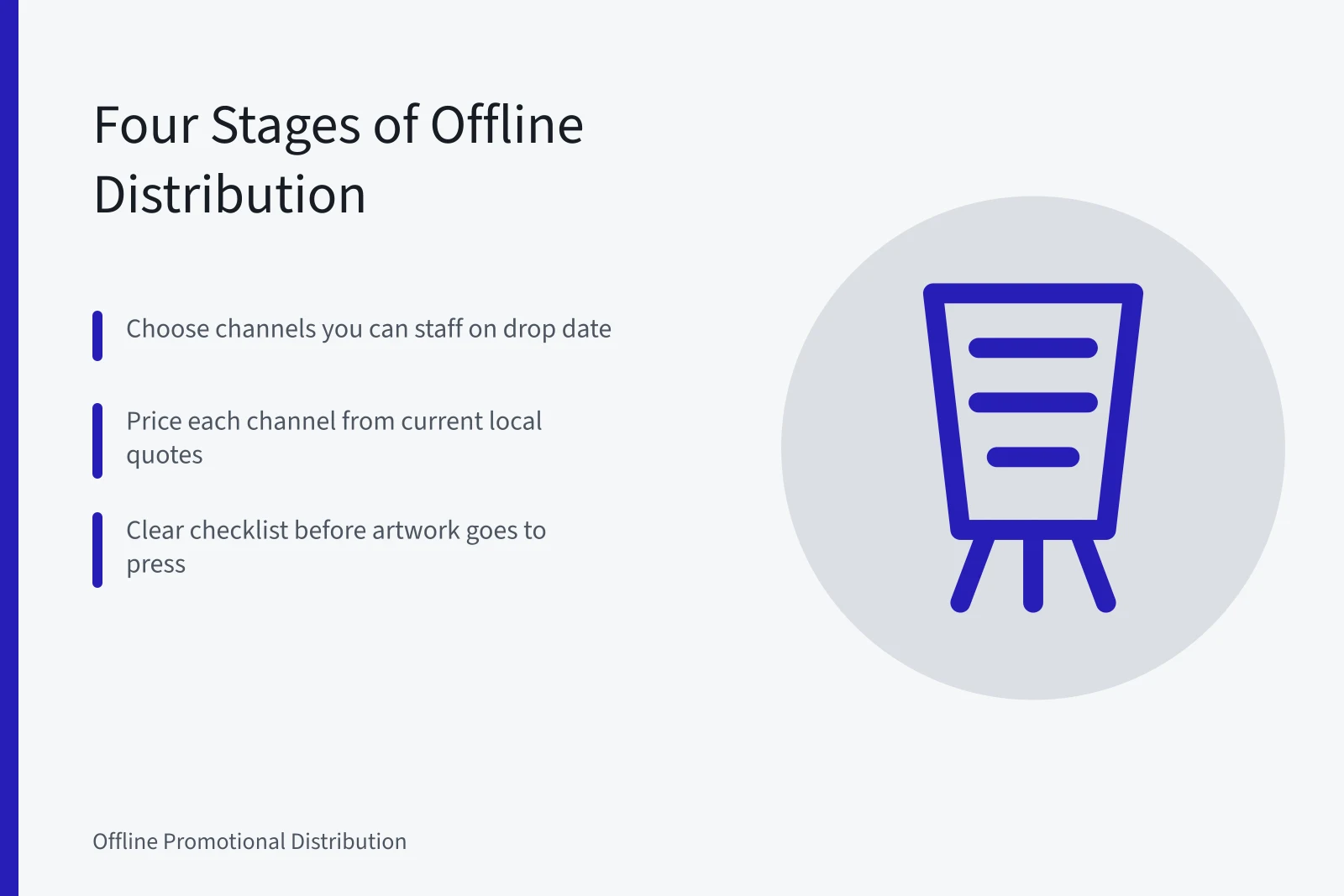
- Choose channels and confirm you can staff each one on the drop date.
- Price each channel from current local quotes, not from last year's sheet.
- Clear the checklist before artwork goes to press.
- Book freight and name the person who signs for the pallet.
Price local promotional distribution costs
No single rate card covers every channel, so price each one against its own driver.
| Channel | Main cost driver | Confirm in writing |
|---|---|---|
| Direct mail | Print, postage, list quality | Drop dates and postal paperwork |
| Newspaper insert | Circulation based rate card | Insertion date and zone |
| Trade show | Booth square footage, drayage | Floor plan and load in window |
| Sponsorship | Membership or package tier | Deliverables and logo placement |
| Outdoor board | Placement, size, market | Contract length and artwork spec |
| Event sampling | Staffing hours, permits | Site rules and waste removal |
Rates shift by market and season, so reprice before each campaign instead of reusing last year's sheet. Date every quote you keep and note who supplied it.
Run the promotional distribution checklist
Work the list in order. Skipping a line moves the problem downstream to the printer or the freight dock.
- Audience list built and address quality checked
- Offer and claims reviewed against FTC advertising and marketing guidance
- Print spec signedsize, stock, quantity, and overage allowance
- Tracking assigned per channel, using a QR code with a unique URL as described on the Wikipedia QR code page
- Freight, delivery window, and receiving contact confirmed
- Safety and labeling requirements checked for items aimed at children
The last line matters more than it looks. Federal rules require testing and certification for children's products, and promotional goods are not exempt.
Example: a four week apparel drop in the Midwest
A regional beverage maker orders 600 printed tees and 200 embroidered caps for a three state spring tour.
Week one covers artwork and digitizing. Week two takes proofs and approvals. Week three runs the presses. Week four loads freight.
Midwest buyers often keep digitizing, screen print runs, proofing, and interstate freight with one vendor. The Chicago embroidery and screen printing guide for Midwest promotional apparel walks through that sequence.
Plan the handoff and the freight
Delivery is where distribution plans lose time. Confirm who signs for the pallet, what happens if the truck arrives early, and how a short shipment gets counted.
Print a receiving sheet before freight leaves the dock. It should list carton counts, SKU, event date, and the name of the person accepting delivery.
For campaigns that also run by mail, the complete guide to direct mail marketing for 2027 campaigns covers audience definition, offer wording, production control, postal compliance, fulfillment, and measurement.