Costs
Part of Reviewing promotional product marketing: strengths, gaps and a verdict
Promotional product marketing companies: evidence to request before buying
Check promotional product marketing companies before buying: roles, safety and supply chain records to request, cost areas, sample tests, contract terms to confirm.
What to take away
- Promotional product marketing companies do not win every brief: distributors, decorators, and platforms own different parts of the job.
- Ask each finalist for the factory name, the decoration site, and the test report that covers the finished item.
- Get the full landed cost in writing, including setup, freight, duty, and reprints.
- Reproduce one published claim with your own numbers before you sign.
- Keep the losing quotes and the trial notes; the next buyer needs the tradeoffs.
Named companies and the evidence they publish
Most promotional product reviews sort suppliers into four roles. They are direct distributors, wholesale suppliers, print-on-demand platforms, and distributor networks. The named firms below cover the main roles. Compare them on published evidence, not on sales copy.
4imprint is a direct distributor. It sells decorated goods from its own catalog, prints a free sample of your logo, and publishes list pricing on every product page. It suits a buyer who wants one invoice and no factory contact. Ask for the factory name and finished-item test report, because a catalog page does not show either.
SanMar is a wholesale supplier of blank and decorated apparel. It sells to distributors, not end buyers. Its catalog covers brands such as Port Authority and District. Wholesale pricing and stock sit behind a distributor login. It suits an agency that already has a reseller account. Request its factory list and social compliance records before you quote a client.
Gemline is a wholesale supplier of bags, drinkware, and writing instruments. It is distributor-only. It runs its own decoration and fulfillment, which shortens the chain when a program needs bags and bottles together. Ask for compliance documents and the decoration site name. Published pricing is not public, so compare quotes.
Printful and Printify are print-on-demand platforms. They decorate apparel and accessories one unit at a time and ship direct. Both publish per-item pricing and production times. They suit small runs and dropship programs, not a 5,000-unit event order. For safety evidence, request the blank supplier and the ink or transfer specification used on your item.
Boundless and Stran are distributor networks rather than single suppliers. They give member distributors access to many factories under one account. They suit a buyer who needs sourcing reach without building factory relationships. Stran & Company files public reports as a Nasdaq-listed firm, so its corporate finances and risk factors are visible. Boundless members still need factory-level safety records per order.
A promotional product marketing program usually mixes two or three of these. Name which role each finalist plays before you score it.
Named companies and evidence
| Company | Role | Published pricing evidence | Safety and supply visibility |
|---|---|---|---|
| 4imprint | Direct distributor | List price on product pages; free logo sample | Factory name and finished-item test report on request |
| SanMar | Wholesale apparel | Wholesale price behind distributor login | Factory list and social compliance records on request |
| Gemline | Wholesale bags, drinkware, writing instruments | Account pricing only | Compliance documents and decoration site on request |
| Printful | Print-on-demand | Per-item pricing and production times public | Blank supplier and ink spec on request |
| Printify | Print-on-demand | Per-item pricing and production times public | Print provider and blank supplier on request |
| Boundless | Distributor network | Quote-based | Factory-level safety records per order |
| Stran | Distributor network | Quote-based; SEC filings public | Public reports; factory safety records per order |
Score the operating chain
Area / Question
- Product fit
- Can the supplier meet the written user and environment requirements?
- Safety
- Does the test report name the finished item, the lot, and the market?
- Supply chain
- Are factory, components, decorator, and substitutions named?
- Quality
- Are tolerances, inspection, rework, and remedies defined?
- Rights
- Are artwork sources, permissions, and approvals on file?
- Data
- Are recipient fields minimized, secured, and deletable?
- Delivery
- Can counts, shortfalls, and returns be reconciled?
- Commercial
- Are full price, timing, liability, and exit stated?
CISA's page on information and communications technology supply chain security describes federal supply chain risk work. It does not certify merchandise suppliers. The transferable habit is naming dependencies and monitoring changes. A promotional product marketing checklist applies that habit to the recipient, the item, and the delivery.
Score the operating chain
- Product fitmeets user and environment requirements
- Safetytest report names item, lot, market
- Supply chainfactory, components, decorator named
- Qualitytolerances, inspection, rework, remedies defined
- Rightsartwork sources, permissions, approvals on file
- Datarecipient fields minimized, secured, deletable
- Deliverycounts, shortfalls, returns reconciled
Verify the business behind the catalog
The SBA guide to buying assets and equipment covers purchase planning for small businesses. Promotional goods carry their own product, advertising, data, and shipping risks, so build a category-specific request.
Verify the business
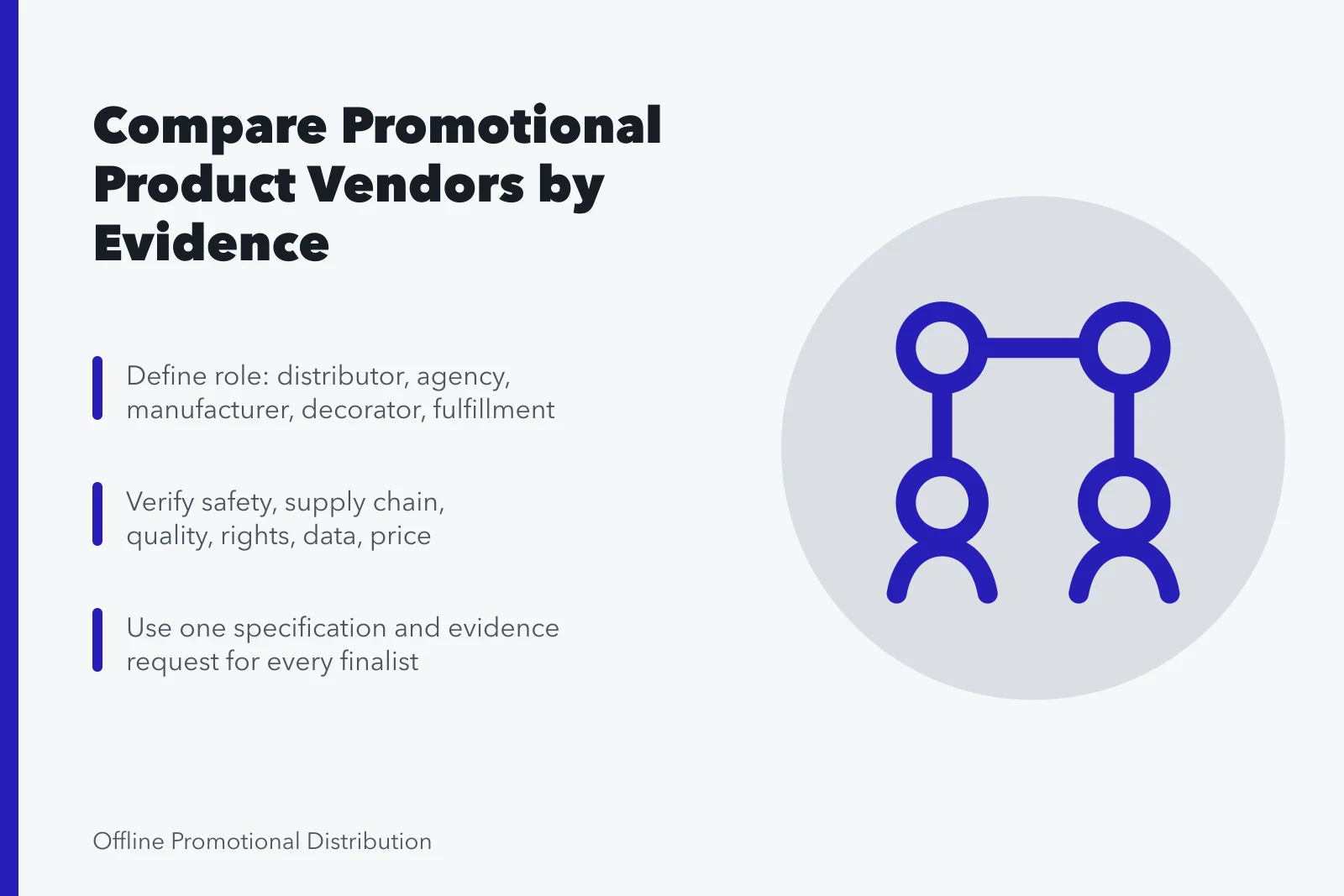
- Send one specification and evidence request to every finalist.
- Verify legal entity, location, insurance, and named subcontractors.
- Inspect samples made on the proposed production line, not a hand-built mockup.
- Test one change, one defect, one export, and one deletion request.
- Compare landed cost, not unit price.
Contract terms should cover specifications, substitutions, approvals, and testing records. They should also cover tolerances, delivery, data handling, and incidents. Terms should address recalls, artwork rights, insurance, and defective work. They should also include reprints, credits, inventory, and transition. Reassess before each new item or market.
Audit the published evidence
The FTC advertising substantiation policy requires a reasonable basis before an objective advertising claim goes out. That applies to a supplier's published performance numbers, including response rates and cost-per-lead figures.
The FTC guidance for marketers using reviews covers fake feedback, selective review requests, conditioned incentives, and undisclosed paid rankings. Apply those checks when a comparison site ranks suppliers.
Separate supplier claims, customer statements, measured records, and independent findings. Record the criteria, the commercial relationship, the product version, the sample size, and what was missing. Reproduce one material claim with your own data before you recommend anyone. If the method is not published, treat the number as a lead to test.
For safety and compliance questions that vary by market, confirm with the U.S. Consumer Product Safety Commission and a certified testing lab. For tax treatment of a promotional item, confirm with the Canada Revenue Agency or Revenu Québec and a CPA. For Quebec creative and packaging rules, confirm with the OQLF and a qualified Quebec lawyer or notary.
Common questions
Should I hire a distributor or a manufacturer?
A distributor gives you one invoice and hides the factory chain; a manufacturer gives you the factory but rarely the decoration, storage, or fulfillment.
Most programs need both, so name which part each finalist owns before comparing price.
If you are still weighing how the pieces fit, these promotional product marketing questions get answered without the hedging.
Are samples enough to approve a company?
No. A sample proves the item can be made once, not that the production line holds tolerance across a run. Ask for the test report on the finished item, the factory name, and the rework terms alongside the sample.
How should price be compared?
Compare landed cost across these areas:
- goods
- setup
- decoration
- testing
- freight
- duty
- storage
- fulfillment
- defects
- replacements
- closure
As of 2026, typical print-on-demand apparel runs about $8 to $25 per unit before shipping. Decorated distributor orders often land from $12 to $35 per piece at 250 units. Setup charges commonly add $30 to $75 per color or location. Freight and duty vary by weight, distance, and country of origin, so compare the delivered total.
A low unit price with a separate setup charge and no reprint credit is usually the more expensive option.