Strategy
Part of Reviewing promotional product marketing: strengths, gaps and a verdict
Promotional product marketing tools judged on daily use
Promotional product marketing tools judged on daily use, covering what each does, who it suits, and where it breaks under real campaign volume.
What to take away
- CommonSku and SAGE hold supplier and product records; neither certifies safety, claims or rights.
- Distributor ERP (ASI Central, SAGE Order Management) carries the order; artwork tools carry the proof.
- Compliance lives in Proforma Safety Data Sheets and third-party lab reports, not in a catalog listing.
- Price setup, corrections and exit, not the subscription. Export is the test that matters.
Named tools, priced and judged on daily use
CommonSku is the promotional products industry product database run by PPAI. Distributors pull supplier data, pricing and images into quotes. Access comes with PPAI membership, and dues scale with sales volume on PPAI's published schedule. Daily use rewards search speed and clean image pulls. It stalls on stale supplier records when no one owns the fix.
Pick CommonSku if your team lives in supplier data and you will assign record cleanup. Skip it if no one owns that cleanup.
SAGE is the competing supplier database and business platform. Beyond product search it carries order management, virtual samples and website tools, so quoting and tracking sit behind one login. It suits firms that want the catalog and the back office from one vendor.
Pick SAGE if you want catalog and order management behind one login. Skip it if you need a public month-to-month rate card or lightweight exports.
SAGE prices by subscription tier, user seats and order volume, not a public rate card. Daily use saves re-keying between quote and order. The tier line gates reports and exports, so run an export before you commit.
Compare your peak campaign month, often 500 to 2,000 orders for a small distributor, against the order and SKU caps on each tier.
ASI Central (Advertising Specialty Institute) is the third major database, tied to ASI's distributor network and marketing programs. It suits distributors already buying through ASI-listed suppliers. Membership pricing follows ASI member tiers based on sales volume, not a public rate card. Daily use connects a listing to ASI marketing programs, which helps campaign work. Data depth still depends on what each supplier loaded.
Pick ASI Central if you already buy through ASI-listed suppliers and use ASI programs. Skip it if you need the deepest supplier data or a standalone catalog.
Verdict by distributor type: CommonSku wins for PPAI-member distributors that live in supplier data; SAGE wins for firms that want catalog plus order management behind one login; ASI Central wins for distributors already buying through ASI-listed suppliers.
Zoho Inventory and Cin7 are general inventory and order systems, not industry-specific. Both handle stock, purchase orders and fulfillment, and both export to CSV. Zoho publishes a free tier for low order volume, then paid tiers. As of January 2025, Zoho's published paid tiers for Inventory run from $29 to $129 a month per organization. Cin7 publishes Core and Omni tiers; request current pricing because it scales with orders, users and integrations.
Daily use suits distributors running warehouse stock beside drop-ship. Under campaign volume the weak point is reconciliation: reconcile a weekly count of 50 to 200 SKUs against physical counts, or unit counts drift unless one person owns the check.
Pick Zoho if you want a free start and low order volume. Pick Cin7 if you run warehouse stock beside drop-ship. Skip both if you need industry-specific product data.
Canva and Adobe Illustrator carry artwork and proofs. Canva suits fast, templated decoration mockups and keeps a free tier; as of January 2025, Canva Pro is published at $15 a month per user or $120 a year. Illustrator suits vector work and print-ready separations. Adobe lists it as a single-app subscription, published near $23 a month on an annual plan as of January 2025.
Daily, Canva produces a mockup in minutes and Illustrator produces a separation in minutes. The gap shows when an approved proof changes, because sources, rights and versions have to stay visible in both.
Pick Canva if you need fast templated mockups. Pick Illustrator if you need vector separations and print-ready files. Skip Canva if your proofs require complex production separations.
For the workflow these tools sit inside, see promotional product marketing.
Acceptance tests by tool
| Tool | Acceptance test |
|---|---|
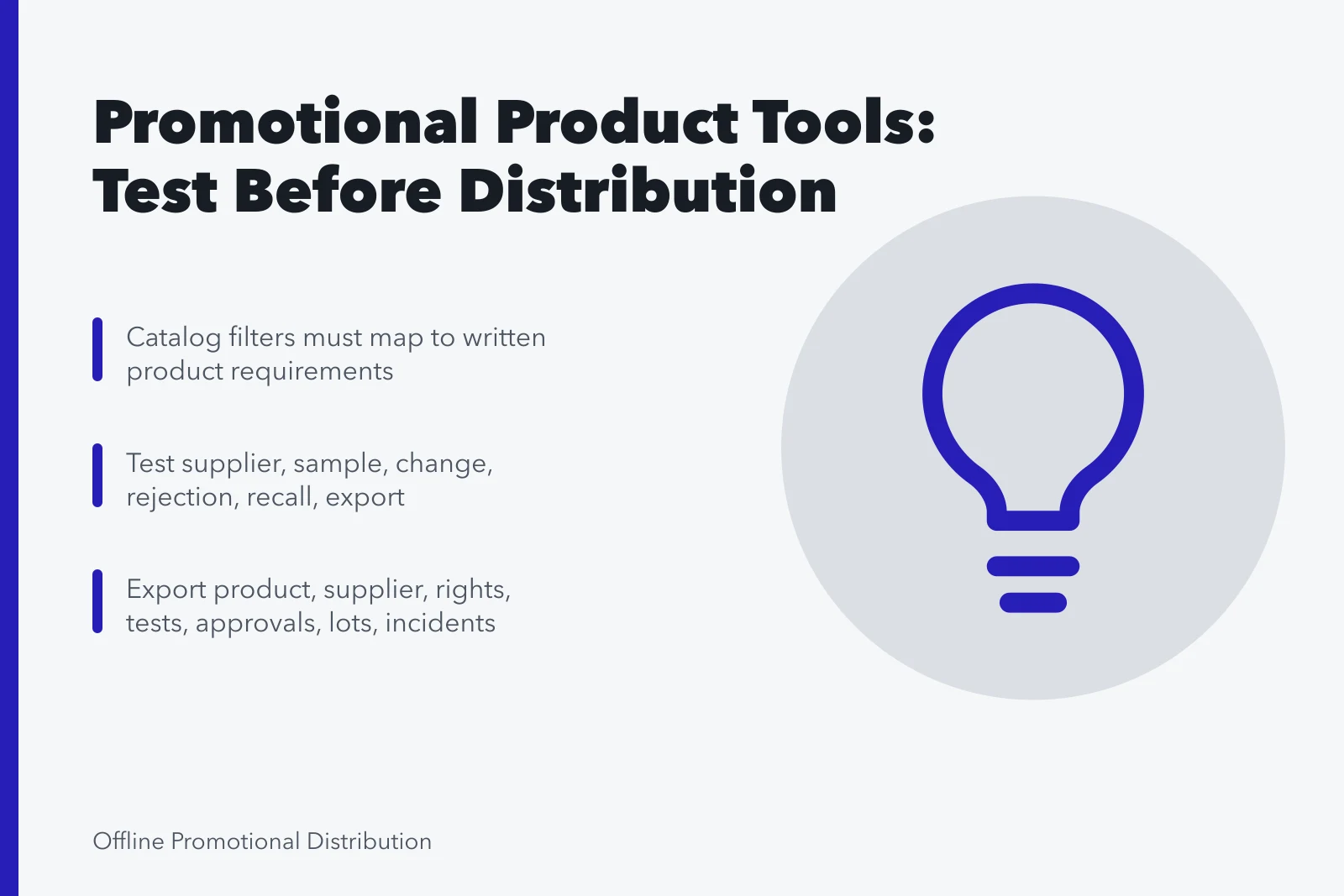
| CommonSku, SAGE, ASI Central | Filters map to written product requirements |
| Zoho Inventory, Cin7 | Accepted, rejected, shipped and held units reconcile |
| Canva, Illustrator | Sources, rights, versions and approvals stay visible |
| Proforma Safety Data Sheets | Exact model, components, factory and lots stay linked |
No vendor in this comparison publishes a named acceptance-test result. The table is your test plan, not a vendor scorecard.
The CPSC recall database lets users search published U.S. recall notices. A search result does not certify products that are absent, and similar-looking items may have different components or histories. Use exact identifiers and qualified product review.
Environmental claims need the exact product
USDA's BioPreferred Catalog lists products in its federal context. A listing supports only the claims and scope the program documents. Verify the exact product, current status, performance needs and safety separately.
- Require individual logins and audit records
- Keep authoritative product and claim sources outside free-text notes
- Link quantities to physical counts and named locations
- Protect recipient addresses, sizes and choices
Run one sample job through every finalist using synthetic or approved data. Include a changed material, failed test, artwork withdrawal, rejected batch and shipping exception. Choose the smallest system that preserves evidence and lets accountable staff stop work.
Record which tool is authoritative for each object. Two catalogs or inventory records that disagree without an owner make traceability worse than a controlled shared register.
Measure operating burden
The GOV.UK technology selection guidance recommends adaptable choices, data control, security review and ownership-cost analysis. Use those public-service questions when assessing promotional product marketing tools; they are not product endorsements.
The GOV.UK open standards guidance covers data portability. Test whether product data and definitions can move between CommonSku, SAGE and your ERP without a re-keying project.
Measure setup time, recurring labor, specialist help, correction work and shutdown effort.
A feature earns credit only when an intended user completes the task safely. Save the tested plan and date: a current product page does not promise the same function or price in 2027.
Set the next review date and name the change that triggers an earlier check. Record rejected options and the chosen path, because the original constraint may later change. Close unused reports and permissions once the decision cycle ends.
Common questions
Is a supplier catalog a compliance tool?
No. CommonSku, SAGE and ASI Central are discovery sources. Verify the exact final product, claims, tests, labels, market and production chain. For CPSIA, children's product or toy rules, confirm with the U.S. Consumer Product Safety Commission and a certified testing lab.
Should inventory and marketing data be combined?
Only where a defined operational purpose, access model and retention rule support the connection. Zoho Inventory and Cin7 both export to CSV, so a shared key beats a shared database.
What must be exportable?
Items to track:
- Product
- supplier
- rights
- tests
- approvals
- lots
- quantities
- incidents
- costs
- outcomes
A CSV export and field mapping for a catalog of 500 to 2,000 SKUs typically takes 20 to 40 staff hours. If a vendor charges for that export, get the fee before signing. If a vendor cannot produce that list as a file, the exit cost is the real price.
Who sets the rules that vary by market?
Licensing, sanitation and safety requirements vary by state and municipality. Confirm with your state board. For Canadian distribution, GST/HST input tax credits and Quebec's Bill 101 rules sit with the Canada Revenue Agency, Revenu Québec and the OQLF. A CPA and a qualified Quebec lawyer or notary handle the specifics.