Reviews
Part of Reviewing promotional product marketing: strengths, gaps and a verdict
Recipient utility first: promotional product marketing best practices
promotional product marketing best practices connect recipient utility, category safety, choices, supported claims, traceable production, evidence, and closure.
What to take away
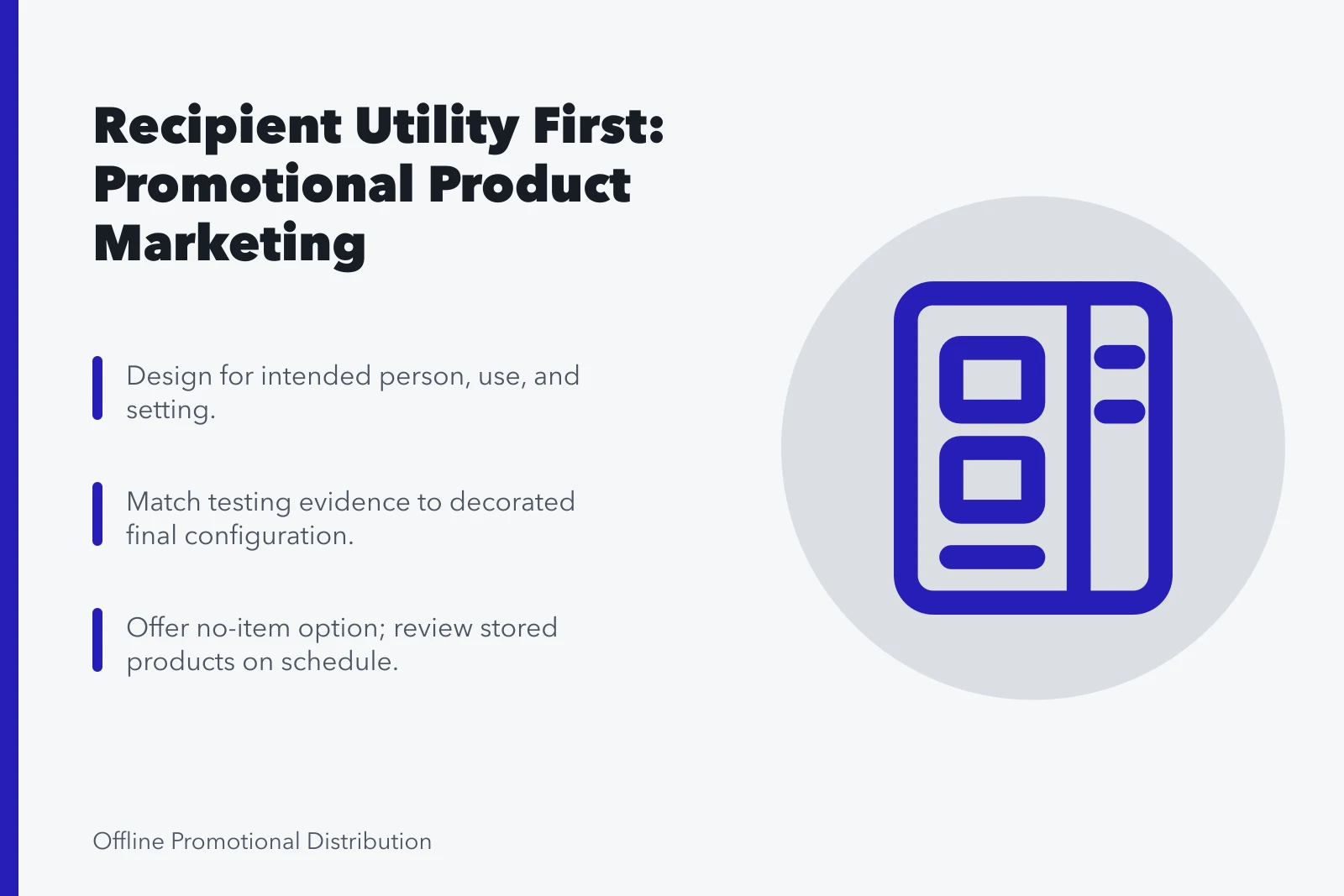
- Design for the intended person, foreseeable use, and actual setting.
- Keep safety and traceability evidence tied to the finished item.
- Offer appropriate choices and a no-item route.
Promotional product marketing best practices turn a giveaway into a controlled product program. The item should solve a relevant recipient problem, meet category and market requirements, carry supported claims, arrive through a fair accessible process, and have a defined end.
Run a product lifecycle
| Stage | Practice |
|---|---|
| Need | Observe recipient task and burden |
| Design | Write material, safety, accessibility, claim, and rights requirements |
| Source | Identify legal entities, facilities, components, and subcontractors |
| Verify | Match testing and evidence to the decorated final configuration |
| Produce | Approve sample, changes, tolerances, and inspection |
| Distribute | Control eligibility, choices, quantities, data, and support |
| Evaluate | Measure mature effect, complete cost, defects, and waste |
| Close | Resolve inventory, incidents, access, records, and end-of-life |
Worked example for Verify: a decorated stainless steel tumbler. Confirm the base blank has FDA food-contact compliance. Confirm the ink and coating meet FDA food-contact rules. The final item passes migration testing. The supplier holds the test report for the exact configuration.
Category rules you must check
- DrinkwareCheck FDA food-contact requirements for the base and decoration. Require migration testing for the finished decorated item.
- Children's productsIdentify applicable Consumer Product Safety Improvement Act (CPSIA) requirements, third-party testing, a Children's Product Certificate (CPC), and tracking-label requirements. For toys, check ASTM F963 as incorporated into CPSC regulations.
- ApparelCheck the flammability standard in 16 CFR 1610 for wearing apparel.
- ElectronicsCheck FCC equipment authorization and, where applicable, UL or ETL listing for the exact model.
- Lithium batteriesObtain the UN 38.3 test summary and confirm applicable U.S. Department of Transportation hazardous-material shipping requirements before shipping.
- Cosmetics and topical itemsCheck applicable FDA labeling and ingredient rules.
- State requirementsCheck California Proposition 65 warning obligations and other state chemical and labeling rules for the item and intended distribution.
- ClaimsSubstantiate claims such as “BPA-free,” “made in USA,” “recycled,” and “compostable” for the exact product and market. The FTC Green Guides (16 CFR Part 260) apply to environmental claims. An unqualified “Made in USA” claim requires that all or virtually all of the product be made in the United States.
Before approving a claim, write the exact consumer-facing wording and market, match evidence to the finished product and wording, and keep the evidence source, date, product configuration, and approval with the artwork. Use an unqualified “Made in USA” claim only when the all-or-virtually-all standard is met; where supported, a qualified claim such as “Made in USA with imported parts” can describe a different origin situation. Do not approve environmental claims without evidence supporting their specific wording and conditions.
Worked checks: For a toy giveaway, document intended age and play use, then check applicable CPSIA requirements, ASTM F963 test evidence, the CPC, and tracking-label information against the final item. For a battery-powered giveaway, match FCC authorization and any UL or ETL listing to the exact model, obtain the battery’s UN 38.3 test summary, and confirm applicable U.S. shipping requirements before release.
In the United States, the Consumer Product Safety Commission (CPSC) runs the federal recall database and sets mandatory product safety rules.
For Canada as a second market, Health Canada's overview of consumer product safety links to Canadian safety information, recalls, and business resources. It does not approve a promotional product. Requirements and authorities differ by category and market, so use qualified current review. A promotional product marketing checklist keeps those safety records tied to each item and market.
Check recalls across intended markets
In the United States, search the CPSC recall database by exact product identifier before each order. In Canada, Health Canada's own recall tool publishes notices.
Australia's product-safety regulator, the Australian Competition and Consumer Commission (ACCC), provides a recalls search through Product Safety Australia. Absence from search results is not evidence that an item is safe or compliant. Search exact identifiers and retain final-product testing, supplier, lot, and distribution records.
- Select fewer, more useful items
- Use plain instructions and accessible alternatives
- Keep claim qualifications visible
- Require written approval for material or factory changes
- Reconcile units and protect recipient data
- Give staff a fast incident and stop-distribution route
Select suppliers with evidence
Ask for the supplier's legal entity name, factory address, quality certificate and the standard it covers, test reports for the exact decorated configuration, the issuing lab and its ISO/IEC 17025 accreditation scope where applicable, subcontractor list, insurance, and change-notification process.
Require written approval before any material, component, or factory change. Check the supplier against CPSC and Canadian recalls. Low unit price can hide testing, freight, or compliance costs.
For industry-specific supplier context, consult the Promotional Products Association International (PPAI), the Advertising Specialty Institute (ASI), and the Promotional Products Professionals of Canada (PPPC). Ask suppliers to identify any written code of conduct or ethics they follow and how they check compliance. Association membership or a voluntary code does not replace product-specific test reports or legal review.
Budget for the full program
Testing and legal-review needs for a decorated food-contact or children's item depend on category, SKUs, decoration method, and market. Ask the lab and legal reviewer for dated written quotes that identify the configuration, work included, exclusions, and quote validity; keep each quote's issuer and date with the budget.
Budget for product cost, decoration, freight, testing, legal review, storage, distribution, and end-of-life. Keep the source and date for each cost entry, and calculate cost per recipient by dividing total program cost by the number of items that reach recipients, not by relying on unit price alone.
Review long-lived stock on a schedule. Product condition, contact details, safety information, campaigns, claims, rights, recipient rules, and regulations can change while boxes remain in storage. Quarantine any item whose suitability or evidence can no longer be confirmed.
Invite representative recipients into product testing when appropriate. Observe opening, setup, fit, carrying, cleaning, storage, instructions, and disposal. Record access needs and problems without pressuring participants to praise a free item, and route any safety issue immediately.
Name an owner and set a review cadence
Use the common promotional product marketing questions to set a written brief for each campaign, including the recipient need, intended use, item requirements, distribution plan, and owner for approvals.
Keep order-level records that connect approved artwork and claims to the finished item, supplier, factory, test reports, quantities received, distribution, and any changes. Limit recipient data to what the distribution process needs and assign an owner for access and deletion.
Name one owner for each practice. Set a review cadence: before each order, after any supplier change, and at a fixed annual date. Record input, output, acceptance test, and correction path.
Test the distribution and stop-distribution process during a normal campaign and a controlled incident exercise. Confirm that the team can identify affected stock and recipients from retained records, then record any gaps, the correction, and the trigger for an earlier review. Keep rejected options beside the chosen path.
Common questions
What is the safest promotional product?
Safety depends on the exact product, users, use, components, manufacture, evidence, instructions, and market; no category is universally safe.
Why offer a no-item option?
It respects preference, access, workplace rules, privacy, travel burden, and waste reduction.
How often should stored products be reviewed?
Use a documented schedule and review immediately after relevant safety, claim, rights, contact, condition, or program changes.