Rules
Part of Reviewing promotional product marketing: strengths, gaps and a verdict
Reading promotional product marketing trends with a cool head
promotional product marketing trends in 2027 include smaller runs, product passports, provenance, fulfillment, traceability, repair, and lifecycle evidence.
What to take away
- Treat trends as testable signals rather than forecasts.
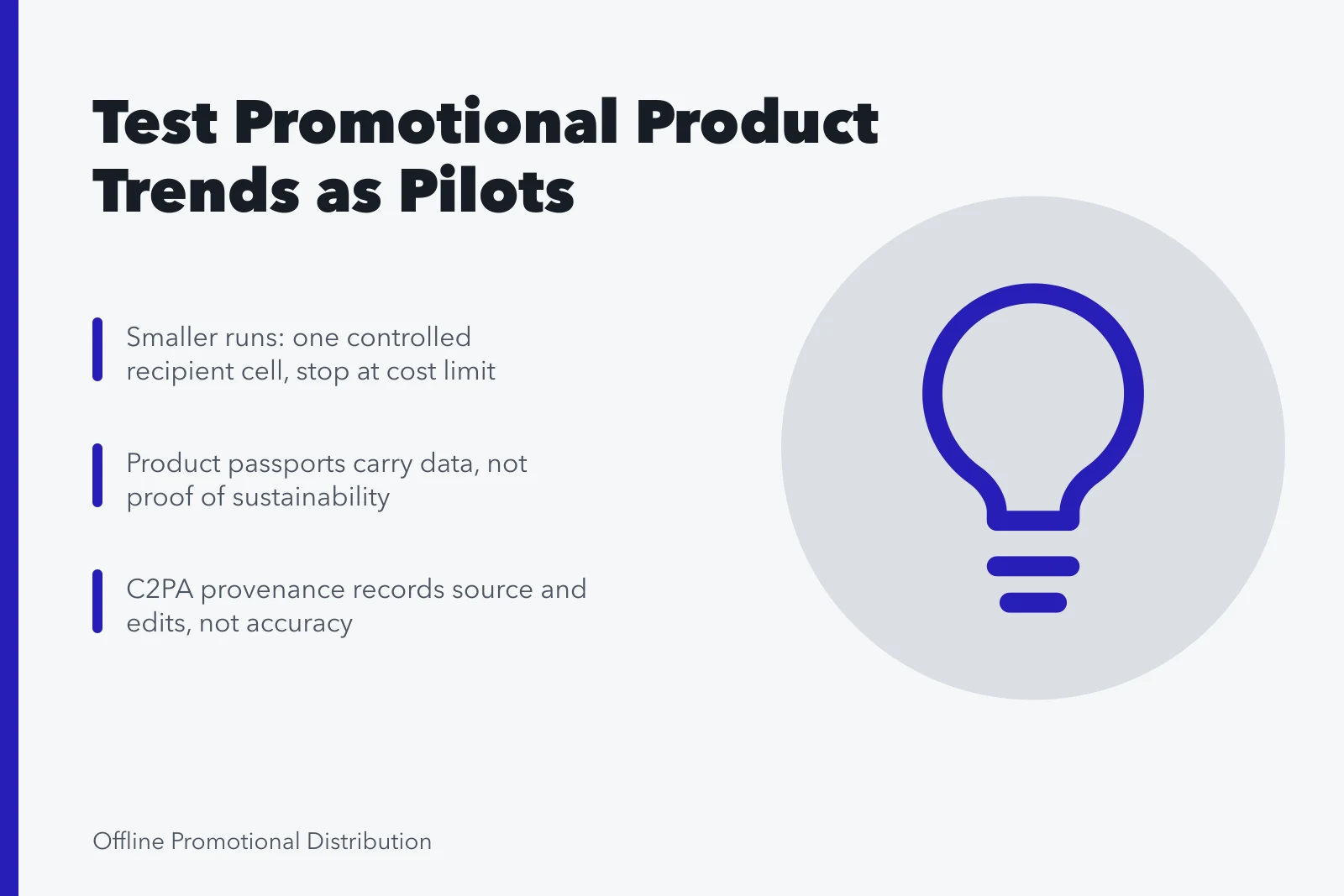
- Product passports and provenance records do not prove safety or truth by themselves.
- Flexible production can reduce stock only when forecasts and controls improve.
Turn each trend signal into a bounded pilot
Promotional product marketing trends in 2027 point toward smaller production runs, recipient choice, deeper traceability, digital product information, media provenance, repairable or reusable formats, reduced packaging, and closer measurement of useful outcomes and waste.
The European Commission's ESPR working plan, published in April 2025, put apparel and footwear among the first priority product groups.
The EU battery passport, required for certain batteries from 18 February 2027 under Regulation (EU) 2023/1542, is the first dated product passport duty in a consumer category.
| Signal | Pilot | Stop rule |
|---|---|---|
| Smaller runs | Produce one controlled recipient cell | Unit cost more than 15 percent above the standard run, or more than three variants |
| Recipient choice | Offer two suitable options and no item | Access or privacy gap appears |
| Product information | Link one current care or safety record | Destination becomes wrong or unavailable |
| Provenance | Carry one asset's rights record into production | Source or approval is lost |
| Repair or refill | Test one supported useful-life extension | Safety or return burden is unacceptable |
| Lifecycle evidence | Count material, movement, use, and end-of-life | Method cannot support the claim |
Treat the unit-cost gap of 10 to 15 percent as a typical cap, not a standard, alongside a limit of three variations and scrap at or under 5 percent of the batch. Your own cost base decides the exact figure.
The European Commission describes the Ecodesign for Sustainable Products Regulation and related policy direction, including product information measures. Applicability, timing, delegated rules, and product scope require current qualified review. The page does not validate a promotional item's environmental claims. Any environmental claim on a promotional item still needs evidence, which is where promotional product marketing best practices start.
In the United States, the Federal Trade Commission enforces environmental marketing claims under the Green Guides, 16 CFR Part 260, and Section 5 of the FTC Act.
California adds AB 1305 for carbon offset and net-zero claims, and SB 253 and SB 261 for climate disclosure via the California Air Resources Board.
In Canada, the Competition Bureau applies the Competition Act, including the environmental claims provisions added by Bill C-59, which received royal assent on 20 June 2024. Health Canada sets product safety requirements.
Signal to Pilot to Stop Rule
Signal
- Smaller runs
- One controlled recipient cell
- Recipient choice
- Two suitable options, no item
- Product information
- Link one care record
- Provenance
- Carry one asset's rights record
- Repair or refill
- Test one useful-life extension
- Lifecycle evidence
- Count material to end-of-life
Pilot
- Smaller runs
- Cost or variation exceeds limit
- Recipient choice
- Access or privacy gap
- Product information
- Destination wrong or unavailable
- Provenance
- Source or approval lost
- Repair or refill
- Safety or return burden
- Lifecycle evidence
- Method cannot support claim
Stop rule
- Smaller runs
- Recipient choice
- Product information
- Provenance
- Repair or refill
- Lifecycle evidence
Treat creative provenance as a record, not proof
The C2PA technical specification defines structures for content provenance and authenticity. Credentials can help carry source and edit information, but they do not establish that a product image, claim, license, or campaign conclusion is accurate or complete.
- Document the recipient problem before adopting a feature
- Use the smallest reversible production batch
- Keep product and creative source evidence
- Test scanning, access, privacy, and long-term destination ownership
- Measure mature value, defects, burden, and leftover units
- Retire obsolete physical and digital information together
The useful direction is accountable reduction: fewer speculative goods, clearer product records, stronger recipient choice, and better closure. A trend deserves scale only after the team can show that it improves the intended task without shifting safety, data, accessibility, or environmental burden elsewhere.
Run the watchlist as dated steps
The NIST AI RMF Playbook offers voluntary AI-risk actions under govern, map, measure, and manage. Use them when AI changes promotional product marketing trends; the playbook is not a product ranking or forecast.
The W3C Privacy Principles statement gives web-system designers shared privacy concepts and warns against shifting privacy work to individuals. Apply it to promotional product marketing trends, then review the governing law and configuration.
Run the watchlist in this order:
- Label each item as shipped, limited release, preview, announced, or inferred.
- Name the affected workflow, source, owner, test, and rollback condition.
- Recheck each source at the purchasing date and again before adoption.
- Set a review date and name the change that would trigger an earlier check.
- Record rejected signals beside the chosen pilot, because a constraint that ruled one out may not hold next year.
A current release can support a planning signal, but it cannot support a guaranteed 2027 capability, price, adoption rate, or business outcome.
Promotional product marketing trends move faster than anyone's memory of why a choice was made. Keep the evidence beside the decision so a reviewer can reproduce the reasoning.
Interface, export, meeting note, and correction log should share one set of definitions. Close unused reports and permissions once the cycle ends. Shared definitions also decide how you answer common promotional product marketing questions about quantities, distribution, and measurement.
Common questions
Will digital product passports prove sustainability?
No. They may carry information, but claim quality still depends on scope, evidence, governance, and current product facts.
Are smaller runs always greener?
No. Evaluate material, setup, energy, freight, packaging, durability, defects, use, and end-of-life for the actual program.
Which trend should be tested first?
Choose the smallest change tied to a verified recipient need and measurable mature outcome.