Guides
Reviewing promotional product marketing: strengths, gaps and a verdict
Promotional product marketing works when the item does a real job and the cost per outcome is measured, not assumed from impression counts alone.
What to take away
- Promotional product marketing works when the item does a real job for the recipient, not when it only carries a logo.
- 4imprint and Custom Ink sell direct online with published price breaks, Vistaprint serves small orders, and HALO and Staples Promotional Products run account-based programs.
- Canada Post Neighbourhood Mail and Personalized Mail are the two routes most Canadian programs choose between, and the postage rate card decides the budget.
- Quebec distribution adds Bill 101 and OQLF obligations that change the creative before it reaches print.
- CPSIA and children's product rules sit with the U.S. Consumer Product Safety Commission and a certified testing lab, not with the distributor.
- Cost per accepted item, not cost per unit ordered, is the number that survives a post-mortem.
A promotional product is a physical object bought to change what someone does: attend, renew, refer, remember, or try. Apparel, drinkware, bags, tools and awards all qualify. Samples count too. The category is old, crowded and easy to do badly.
This review covers what the channel does well, where it fails, and what a verdict should rest on. The short version: the item is the cheap part. The list, the address data, the compliance file and the measurement plan decide whether the money worked.
Strengths: retention, presence and controlled distribution
Three strengths hold up across markets.
Retention. A useful object stays in a home or truck for years. A digital ad lasts seconds. That gap is the commercial case. It is why a $4 item can beat a $4 cost per thousand impressions.
Physical credibility at the point of decision. A branded pen on a signing desk or a tote at a farmer's market. A mug in a break room also sits where the choice happens, which no banner can claim.
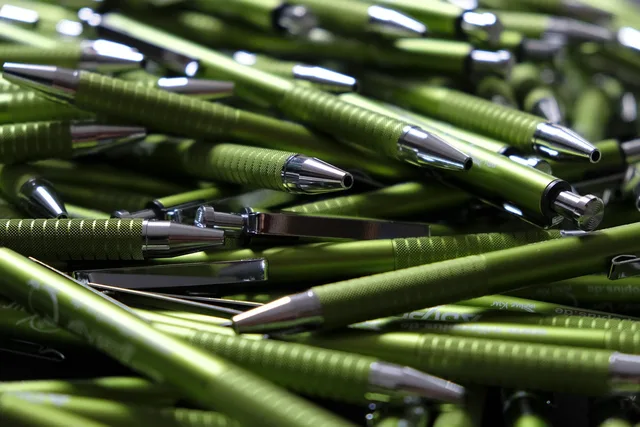
Bic Cristal pens sell in bulk for cents per unit, while YETI Rambler tumblers often retail from $35 and up. Moleskine notebooks commonly run $20 to $30.
Distribution control. You decide who receives it. That makes promotional products a companion to a direct mail marketing drop, where the same address file drives both the mail piece and the hand delivery.
None of these strengths is automatic. Each depends on the recipient keeping the thing.
Gaps: postal accuracy, weak offers and compliance drift
The failures repeat, and they are boring.
Postal accuracy. A Neighbourhood Mail drop reaches every address in a walk. A Personalized Mail drop reaches a named list, and undeliverable addresses still cost money. Canada Post publishes current addressing and sortation requirements, and the rate card changes the arithmetic fast.
Response-rate killers. No offer and no deadline give no reason to act now. A Bic pen with a logo and nothing else is a gift, not a campaign.
Compliance drift. A children's item sourced from an Amazon or eBay listing may carry a certificate for a different model. The certificate does not transfer.
Partner erosion. A distributor who substitutes a factory, a material or a decoration without written approval has changed the product you approved.
Cross-border snags. Goods moving between Canada and the US can stall on classification, duty or broker paperwork. Budget the delay as well as the freight.
Direct sellers and account-based distributors fail in different ways. A direct seller such as 4imprint or Custom Ink gives you published price breaks and a shorter chain. An account program from HALO or Staples Promotional Products adds service and more chances for a substitution.
Costing a campaign in Canada and the US
Postage is the line most budgets get wrong. Canada Post sets rates for Neighbourhood Mail and Personalized Mail separately, and both are published in the current rate card. Work from that document, not from last year's invoice.
Typical North American item costs
- $0.30-$1.50 | custom pen
- $3-$8 | mug
- $5-$12 | basic decorated tee
Build the estimate in named variables:
N= quantity of piecesP= postage per piece for the chosen serviceU= unit cost of the itemF= freight and customs per unitL= labor per unit for assembly or hand deliveryR= expected replacement rate for damaged or undeliverable units
Total cost is N x (P + U + F + L) x (1 + R). Substitute your own figures. No published benchmark substitutes for your own rate card and your own supplier quote.
Provincial sales tax treatment of promotional goods varies. The Canada Revenue Agency and Revenu Québec publish the current rules, and a CPA applies them to your facts. Do not treat a general article as a tax position.
Compliance checks with named authorities
Promotional goods touch product safety, privacy and language law. Each has a named authority.
- Product safety (US).The U.S. Consumer Product Safety Commission publishes recall guidance for businesses. It explains reporting and corrective action. It does not certify your item. A certified testing lab determines which standards apply to the final configuration.
- Children's products.CPSIA rules are stricter than general goods. Confirm the intended age group before sourcing, and get the test scope in writing for the decorated item, not the blank.
- Privacy.Recipient lists are personal data. The W3C Privacy Principles statement gives designers a shared vocabulary and warns against pushing privacy work onto individuals. It is not law and does not replace your own consent analysis.
- Quebec language.Bill 101 and the Charter of the French Language govern commercial creative distributed in Quebec. The Office québécois de la langue française (OQLF) administers it. Confirm French wording and prominence, plus packaging requirements, with the OQLF and a qualified Quebec lawyer or notary before print.
- Evaluation design.The GAO evaluation design guide explains how evaluation questions, evidence and design choices fit together. Use it to pressure-test your measurement plan, not to claim causality.
- Vendor selection.The GOV.UK technology selection guidance recommends choices that can change over time and include ownership cost. Those questions transfer well to choosing a distributor.
What a distributor such as HALO or Staples Promotional Products should prove
Ask every finalist for the same file. That applies to 4imprint and Custom Ink as much as to account-based firms. A distributor who cannot produce it is a risk, not a bargain.
| Area | Evidence to request |
|---|---|
| Identity | Legal entity, facilities, named subcontractors |
| Product | Exact specification, preproduction sample, test reports for the decorated item |
| Rights | Artwork origin, licenses, indemnity terms |
| Production | Proof process, tolerances, spoilage, corrective action |
| Data | Recipient fields, access, retention, deletion |
| Delivery | Packing, tracking, exceptions, reconciliation |
| Environment | Claim basis, material detail, packaging, end-of-life |
| Commercial | Complete price, schedule, change control, exit terms |
A worked example: 5,000 mugs in Ontario
A mid-size credit union wants 5,000 mugs for a branch campaign in Ontario. Assume U = $3.10, F = $0.22, L = $0.15 for kitting and counter handoff, R = 0.03. Postage is zero because the mugs are handed over in branch.
Cost per account at two outcomes
- $60300 new accounts
- $30060 new accounts
Goods cost is 5,000 x ($3.10 + $0.22 + $0.15) x 1.03, which is roughly $17,870 before design, testing and staff time. If the campaign produces 300 new accounts, cost per account is about $60. If it produces 60, cost per account is about $300. The item did not change. The outcome did.
That is the argument for measuring mature outcomes instead of impressions.
The verdict
Promotional product marketing is worth doing when three conditions hold: the item does a job the recipient already wanted done, the list and the compliance file are clean, and the outcome is measured after it matures.
It is not worth doing as a visibility purchase. If the brief cannot name the recipient, the task, the quantity, the delivery route and the primary outcome, the program will produce a warehouse of leftovers and a slide of impressions.
The channel is neither dying nor magic. It is a distribution method with a physical product attached. It rewards the same discipline as any other direct channel: accurate data, honest claims, controlled fulfillment, and a cost per outcome you were willing to state before you started.
That discipline starts with an offline marketing strategy that names the audience, the route and the outcome before a single item is ordered.
Common questions
Is promotional product marketing still effective?
It works where the item is genuinely useful to the recipient and the distribution list is accurate. It fails where the object is chosen for unit price and the outcome is never measured. The channel is not the variable; the brief is.
Which is better, Neighbourhood Mail or Personalized Mail?
Neighbourhood Mail reaches every address in a walk and needs no list. Personalized Mail reaches named recipients and depends on address accuracy. Canada Post publishes current rates and sortation rules for both, and the choice usually turns on whether you have a clean named list.
Do promotional items need CPSIA testing?
Children's products sold or distributed in the US fall under CPSIA, and the requirements are set by the U.S. Consumer Product Safety Commission. A certified testing lab determines the scope for your specific item and decoration. A supplier certificate for a different model does not cover your run.
What paperwork should I keep after a campaign?
Keep the brief and the approved sample record.
Keep test reports for the decorated item.
Keep the rights file.
Keep quantities ordered and distributed.
Keep invoices and the mature outcome data. Keep recipient files only while they have a stated purpose, then delete them.
In this guide
- Promotional product marketing questions, answered without the hedgingcommon promotional product marketing questions cover usefulness, safety, recipients, claims, sourcing, quantities, distribution, tax, measurement, and leftovers.
- How to improve promotional product marketing: the parts worth your timehow to improve promotional product marketing starts with product fit, reliable evidence, controlled quantities, tested distribution, feedback, and mature outcomes.
- Promotional product marketing examples with the reasoning laid barePromotional product marketing examples from real campaigns, with the reason each branded item was chosen and the simple check that keeps the spend honest.
- How to catch and fix promotional product marketing mistakesPromotional product marketing mistakes start before ordering: novelty-first buying, thin safety evidence, unsupported green claims, and leftover stock.
- A promotional product marketing checklist built for real conditionspromotional product marketing checklist covers recipient need, safety, claims, rights, samples, quantities, delivery, measurement, incidents, and closure.
- Benchmarks for promotional product marketing that hold up under auditpromotional product marketing benchmarks need populations, denominators, item context, survey methods, mature outcomes, safety, waste, and complete cost.
- Promotional product marketing tools judged on daily usePromotional product marketing tools judged on daily use, covering what each does, who it suits, and where it breaks under real campaign volume.
- Recipient utility first: promotional product marketing best practicespromotional product marketing best practices connect recipient utility, category safety, choices, supported claims, traceable production, evidence, and closure.
- Promotional product marketing companies: evidence to request before buyingCheck promotional product marketing companies before buying: roles, safety and supply chain records to request, cost areas, sample tests, contract terms to confirm.
- Reading promotional product marketing trends with a cool headpromotional product marketing trends in 2027 include smaller runs, product passports, provenance, fulfillment, traceability, repair, and lifecycle evidence.