Careers
Part of Reviewing promotional product marketing: strengths, gaps and a verdict
How to catch and fix promotional product marketing mistakes
Promotional product marketing mistakes start before ordering: novelty-first buying, thin safety evidence, unsupported green claims, and leftover stock.
What to take away
- A rush to the lowest unit price can leave recipients with products they never use.
- Icons and short labels can imply unsupported environmental or origin claims.
- Quarantine defective products or outdated stock instead of distributing it quietly.
Promotional product marketing mistakes usually begin before ordering. A vague objective, rushed catalog choice, copied artwork, incomplete specification, irrelevant test report, or optimistic quantity can turn a small item into a safety, rights, reputation, logistics, or waste problem.
Two U.S. legal regimes sit behind the most common triggers. The Consumer Product Safety Commission (CPSC) enforces the Consumer Product Safety Improvement Act (CPSIA), which sets testing and tracking-label duties for children's products. Copied artwork and logos fall under copyright and trademark law, and federal trademark rights are recorded in the U.S. Patent and Trademark Office register.
Children's items carry the heaviest duties. Under the CPSIA, a children's product needs third-party testing at a CPSC-accepted laboratory, a children's product certificate for the specific item, and a tracking label on the product and its packaging that gives the manufacturer or importer, where and when the item was made, and the batch it came from. The law also sets limits on lead and phthalates, so a generic safety sheet or an unaccredited report proves nothing. Promotional orders meet these rules as soon as a client asks for a kids' T-shirt, a sippy cup, or a branded toy — a blank that is fine for adults may still be a children's product.
State rules layer on top. California's Proposition 65 requires a clear and reasonable warning before a business knowingly exposes anyone to a listed chemical, and it reaches common promotional goods such as drinkware, apparel, and tech accessories; several states also regulate recycling and recycled-content labels on products and packaging. Check the destination state's rules for the specific item, not the catalog it came from.
Artwork carries its own rules. Copyright protects the illustration itself, while trademark rights arise from use in commerce and federal registration in the USPTO register adds nationwide rights and a public record. Before printing, search the USPTO register, keep the client's written permission or license for every logo and image, and check that the license covers the actual product and quantity — a supplier's assurance is not a license.
Find the error and correction
| Mistake | Consequence | Correction |
|---|---|---|
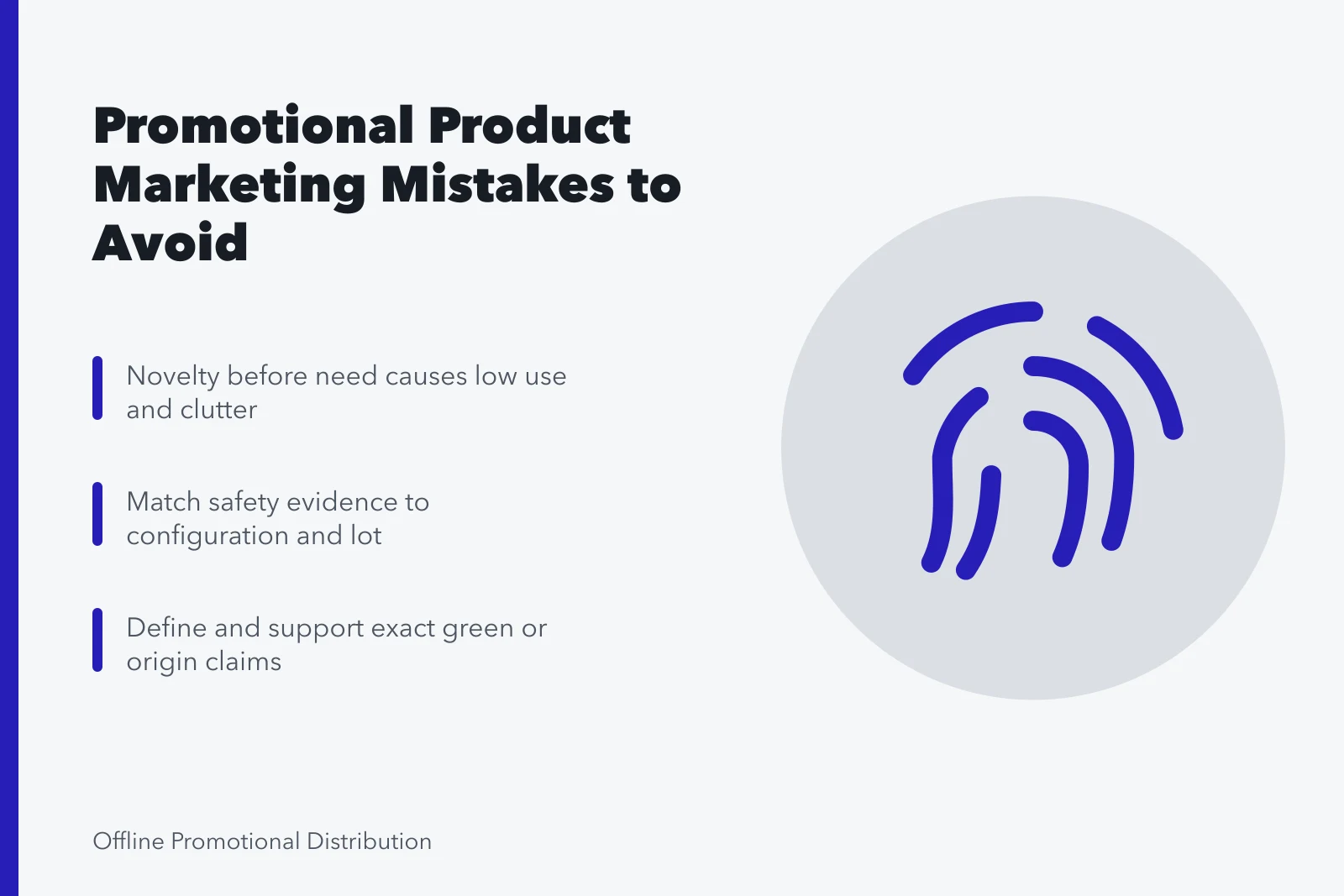
| Novelty before need | Low use and unwanted clutter | Define the recipient task |
| Generic safety document | Final item remains unverified | Match evidence to configuration and lot |
| Loose green language | Misleading environmental impression | Define and support the exact claim |
| Unverified origin label | False source impression | Review current origin rules and evidence |
| Artwork copied online | Rights infringement | Use original or cleared assets |
| Large speculative order | Storage and disposal burden | Forecast acceptance and stage production |
| No incident route | Slow response to harm | Assign stop, trace, notice, and remedy owners |
| Impressions equal ROI | Unsupported performance claim | Measure mature incremental outcomes |
The FTC's page on the Green Guides points to U.S. environmental marketing guidance and related activity. Teams should review current law and evidence for the complete presentation rather than relying on a leaf icon or supplier adjective. Green claims also shape how buyers judge promotional product marketing examples, so the same evidence standard applies to every item.
Check origin claims before printing
Origin is a claim about the finished item, not about the last step. The FTC's guidance on complying with the Made in USA standard uses an "all or virtually all" test: the finished product must be made in the United States with negligible foreign content, and the analysis looks at where the product was last substantially transformed and where its parts came from. On an imported tech accessory or a garment finished abroad, the claim cannot be printed. Pull supplier declarations, bills of materials, and assembly records for the exact item, and treat "assembled in the USA" or "designed in the USA" as different claims from "Made in USA." Keep supply evidence and qualified review for the exact claim, because state and other markets can apply their own rules.
If a defect reaches the market
- Stop production or distribution when a material defect appears
- Identify products, lots, locations, recipients, and connected claims
- Preserve samples, reports, communications, and decision records
- Correct pages, staff instructions, packaging, and fulfillment
- Provide notice and remedy where appropriate
- Change the failed control before the next order
A defect in a children's product that creates a substantial risk of injury also carries a reporting duty to the CPSC; a quiet replacement sent to a few clients does not discharge it. Preserve the units, the test records, and the correspondence while the report is prepared.
Do not solve leftover inventory by extending an expired campaign or giving unsuitable goods to another audience. Reassess safety, claim currency, rights, condition, usefulness, distribution equity, and end-of-life before reuse, donation, recycling, or destruction.
Prove the correction
The GAO data reliability guide treats reliability as fitness for an intended use and requires documented assessment. Applied to an order, that means the evidence has to fit the decision it supports: the same test report, artwork file, or supplier declaration can be sound for one item and useless for another. Use that test for promotional product marketing mistakes; the federal guide does not certify the local data.
The FTC advertising substantiation policy requires a reasonable basis before objective advertising claims are disseminated. Before a catalog page, a proof, or a sales sheet carries a word about safety, performance, materials, or origin, someone must hold the test report, certificate, or supplier record that supports the exact wording.
A mistake is not closed when the design file changes. Trace the correction from the order specification through artwork, proof approval, the supplier's certificate, the packing list, and the receiving check, and keep the old artwork, the reason, the date, and the person who approved the change.
Then test whether the same defect can recur. Pull the next pre-production sample, the next certificate, or the next proof and check it against the corrected specification; that turns an error list into an operating control.
A corrected mistake needs a record a reviewer can reproduce without asking anyone, so file the evidence beside the decision itself.
Date the next review and name the change, a new supplier or claim, that would bring it forward. Note the options you rejected as well as the one you took, because the constraint that decided it may later lift.
Definitions must match across the order form, the proof, the supplier certificate, and the correction log, or one defect gets counted three ways — a tracking label missing on one line and present on another. Close the loop when the corrected item ships, not when the paperwork is filed.
Clean definitions and closed reports support offline campaign measurement, where exposure and outcomes must line up across systems.
Common questions
Is a supplier's green claim enough?
No. The marketer should understand the exact claim, evidence, qualifications, product scope, and current applicable rules.
Can an old item be reused for another event?
Only after reviewing condition, safety, claims, rights, context, usefulness, and equitable distribution.
What should happen after a defect?
Stop affected work, trace units, investigate, notify responsible parties, provide any required remedy, and repair the control.