Strategy
Part of A complete guide to direct mail marketing for 2027 campaigns
Where direct mail marketing trends are heading in 2027
direct mail marketing trends in 2027 include connected mail, postal technology, smaller production runs, stronger provenance, privacy controls, and lift testing.
What to take away
- Three trends are confirmed for 2027Informed Delivery campaign images, QR response tracking on UTM-tagged URLs, and USPS postal promotions published on PostalPro before each program year.
- Two trends are inferred rather than shippedAI-assisted list and copy work, and asset provenance that survives from design file to printed piece.
- A trend earns action only through a bounded pilot with a named audience, a holdout, a cost limit and a stop rule.
- Canada Post Neighbourhood Mail reaches unaddressed households in the second market, and Quebec applies its own language rules to commercial advertising.
The trends confirmed for 2027
Confirmed means the program exists and a mailer can enroll today. It does not mean the tactic will lift response for your audience.
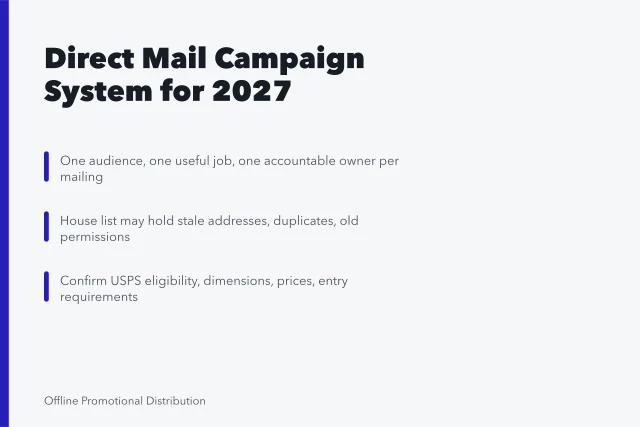
Every trend below has to fit a campaign plan. Direct mail marketing sets out the 2027 structure these tactics plug into, from piece counts through postage.
Promotion names, entry deadlines and discount percentages reset with each program year. Read the current PostalPro promotion page before a designer opens a file. A percentage quoted in an article ages faster than the mailing it describes.
Trends confirmed for 2027
| Trend | Status | Documented at | What changes for the mailer |
|---|---|---|---|
| Informed Delivery campaign images | Shipped | USPS Informed Delivery | The piece earns a digital impression before the carrier reaches the door |
| QR response tracking | Shipped | Google Analytics Campaign URL Builder | A scan is tied to one mail cell instead of a whole drop |
| Postal promotions and eligibility windows | Announced for each program year | USPS PostalPro | A discount applies only when print and data requirements are met |
| Unaddressed household delivery in Canada | Shipped | Canada Post Neighbourhood Mail | Reach without a purchased address list |
| AI-assisted list and copy work | Preview | NIST AI RMF Playbook | Faster variants, plus a governance duty |
QR response is the cheapest trend to test. Give each mail cell its own URL and tag it with UTM parameters. The Google Analytics Campaign URL Builder documents the parameter format, so a scan from one segment is never credited to another.
Two trends that are inferred
AI-assisted segmentation and copy drafting sits at preview. The NIST AI RMF Playbook lists voluntary actions under govern, map, measure and manage. Use it as a risk checklist before a model touches a customer list.
Asset provenance depends on contracts, not on a published standard. Ask the print partner to carry the source file, the rights record and the edit history with the job. Drop any partner who cannot.
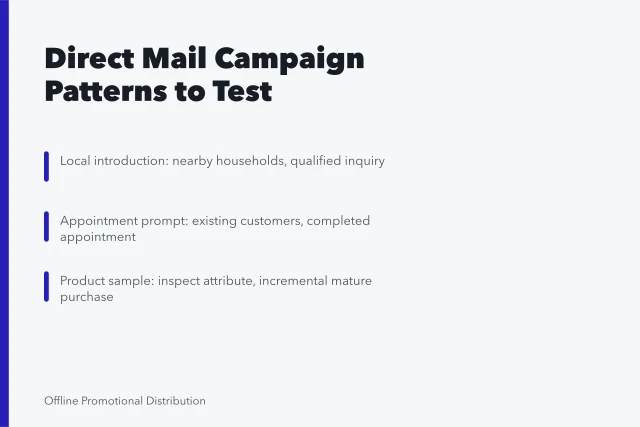
Example: a bounded pilot for one trend
One live drop, six decisions made in advance.
A bounded pilot for one trend
- Choose the trend with the lowest switching cost. For most teams that is QR response tracking.
- Set the audience at about 10,000 households and hold back 2,000 as a comparison group, using holdout sizing from direct mail marketing benchmarks. The holdout receives the same piece without the tracked code.
- Change one variable only, such as the call to action or the landing page.
- Cap spend at a sum the team can lose, typically a mid four-figure amount for a United States mailing that size.
- Write the stop rule before the dropend the test if scans cannot be reconciled with the print run, or if the landing page fails an accessibility check.
- Read the result at six weeks and again at twelve weeks, because mailed response matures slowly.
Signal to Bounded Pilot
Does the signal have a defined pilot and stop rule?
Run bounded test, confirm eligibility
Do not build creative around it
Published response ranges for cold prospecting mail commonly sit between 1 percent and 3 percent of delivered pieces. Treat that as a starting guess and replace it with your own baseline.
Linking printed response to digital measurement
Keep the printed and digital records apart until a validated method joins them.
Connect Physical and Digital Records
- Use a recognizable controlled destination
- State context and material terms on piece
- Minimize customer and household data
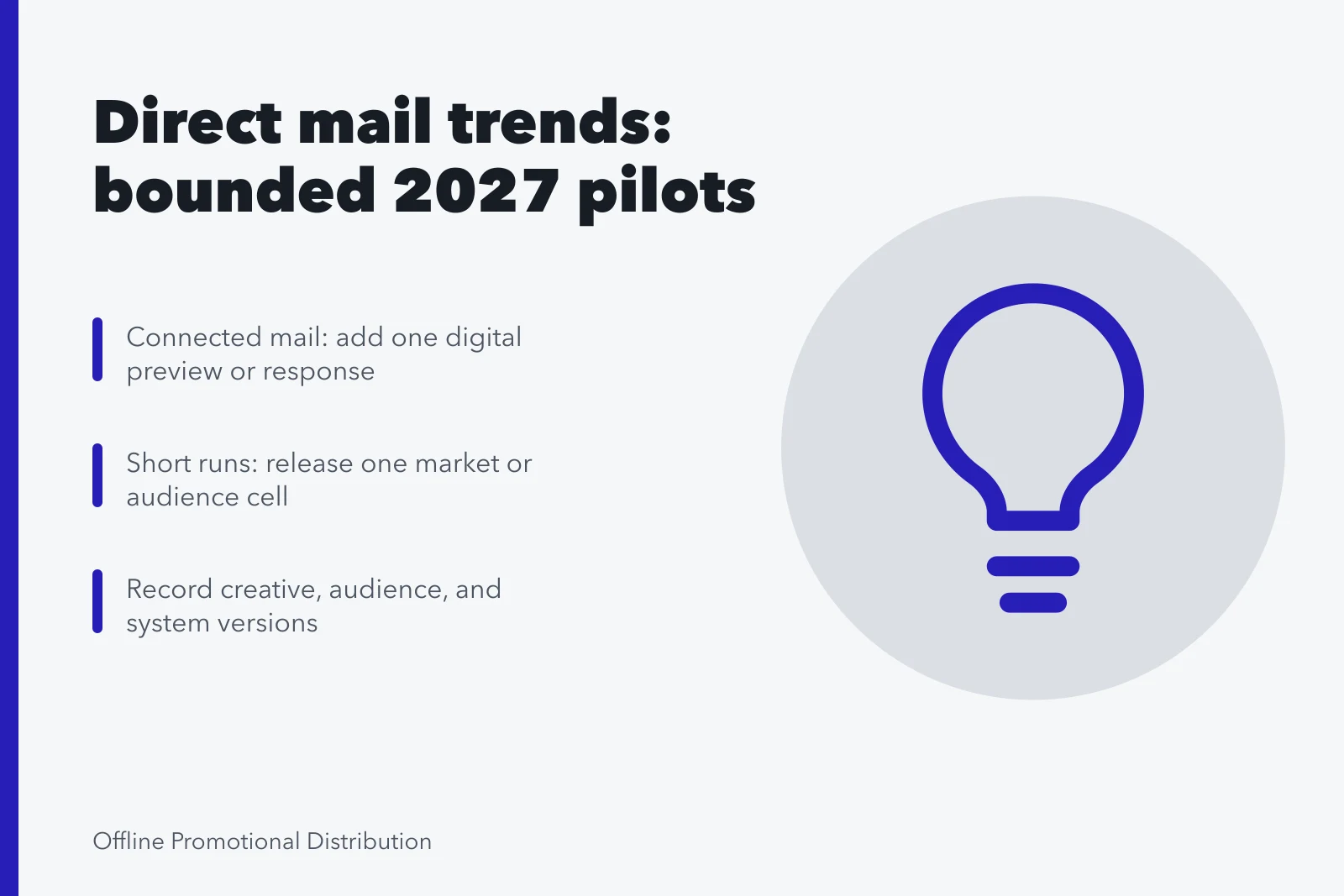
- Record creative, audience, and system versions
- Monitor redirects, forms, calls, fulfillment
- Retire digital destinations and obsolete stock
- One unique URL per mail cell, with UTM parameters matching the naming in the report.
- Consent recorded for every follow-up channel the mailpiece invites.
- Landing pages checked with a keyboard and a screen reader before the drop.
- Digital impressions, scans and orders reported as separate events.
The W3C Privacy Principles argue against shifting privacy work onto individuals. For mail, the team that bought the list owns the consent record, not the household that receives the envelope.
Keep report naming stable across the print vendor, the landing page and the analytics view. If the print house renames a cell, the scan data arrives unlabeled.
Keep these rules beside the promotion eligibility notes on the direct mail marketing checklist, so nobody designs around a program the team cannot enter.
What a small team should do first
Pick one trend and one reading date. Stop there for the quarter.
A trend earns a place in the 2027 plan when one named owner can state the cost limit, the stop rule and the date the evidence gets reviewed.
Keep the evidence beside the decision, including the options that were rejected and why.