Operations
Part of A complete guide to direct mail marketing for 2027 campaigns
Direct mail marketing best practices: the sequence that actually works
direct mail marketing best practices connect audience selection, plain offers, physical proofing, postal accuracy, secure response, fulfillment, and evidence.
What to take away
- The correct sequence ischoose the list source, run NCOA and CASS address hygiene, dedupe and suppress, proof the mailpiece and its material terms. Then test every response route, drop a seed and a control cell, and measure cost per response against that control.
- USPS move-update and address-quality rules apply to the mail class you use, not to a generic mailing.
- Material terms must sit next to the offer and the call to action.
- A random holdout cell and a pre-set cost-per-response threshold are the only honest comparison.
- Close with suppressions, data deletion, and a dated record that another person can follow.
If you need the wider context before you run the sequence, the direct mail marketing guide covers the channel from first principles. The steps below assume you already have a product, an audience relationship, and a budget line.
Run the campaign in seven named steps
- Pick the list source and define the audience. Decide whether the list is house, response, or compiled. Record the source and the permission basis.
- Clean addresses. Run National Change of Address (NCOA) processing and CASS-certified software before every drop.
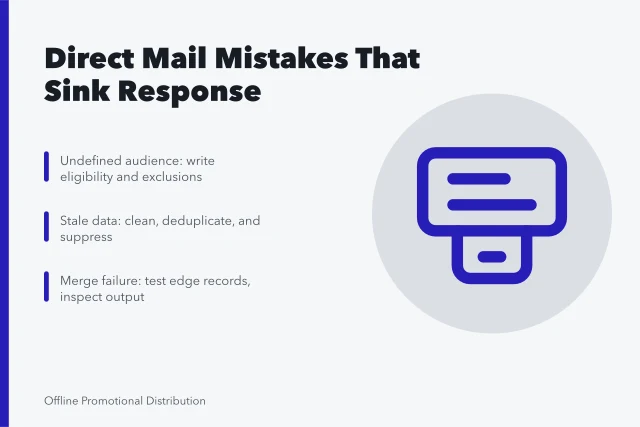
- Dedupe and suppress. Remove duplicates inside the file and against your internal do-not-mail list.
- Build and proof the mailpiece. Check size, stock, folds, and merged data. Place the offer and material terms where the reader sees them.
- Set up response channels. Assign a unique phone number, landing page, or QR code to the drop. Test each route before the mail date.
- Drop a seed and test drop. Mail a small sample to internal addresses to confirm delivery and timing.
- Measure against a control cell. Hold back a random portion of the list. Compare response and cost per response.
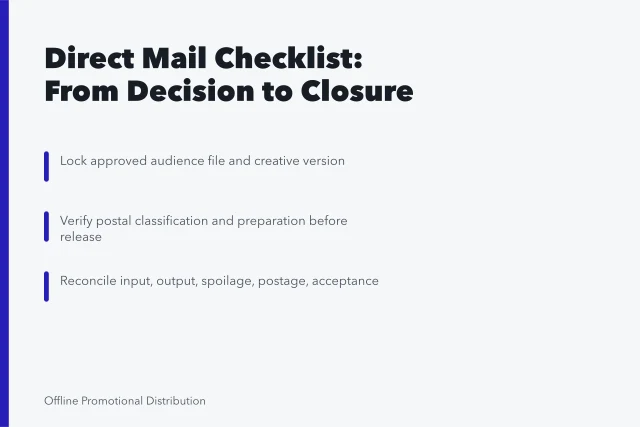
This order protects you from the two expensive mistakes: mailing a dirty list and scaling a result you cannot attribute. Use a direct mail marketing checklist to keep the release packet, postal review, and stop authority in one place.
Clean and update your mailing list
NCOA and CASS are the two named processes that matter. NCOA updates addresses for people who filed a change-of-address with USPS. CASS standardizes addresses to postal format. Both are required for many automation discounts.
Typical practice is to run NCOA every 90 days. Confirm the current USPS Domestic Mail Manual (DMM) recipient services rules for your mail class. Suppression handling needs the same care. Internal opt-outs, litigation holds, and prior undeliverables belong in a dated suppression file.
Dedupe by name and address, not just by last name. Remove duplicates against your house file and your suppression list. Keep a version number for the cleaned file.
Questions about list privacy and suppression often come up late; the common direct mail marketing questions page answers them without jargon.
These controls keep address data, exclusions, counts, and customer correction routes auditable.
Address and Suppression Controls
- Keep source and effective dates
- Apply business, legal, complaint exclusions
- Restrict production access, use secure transfers
- Record selected, produced, spoiled, accepted counts
- Monitor claims and destinations during response
- Give customers correction and contact route
Put the offer and terms on the mailpiece
Material terms must be clear and conspicuous. The FTC advertising and marketing guidance explains that claims need substantiation. Put the price, expiration date, conditions, and return policy next to the call to action. If the offer is a sweepstakes, include official rules or a clear pointer.
Do not hide terms in low-contrast text on the back. The reader should be able to understand the deal without a second document.
Set up response channels and fulfillment
Test every route. A QR code can carry a unique URL and tracking parameters. Use the Google Analytics Campaign URL Builder to add UTM parameters to that URL. That tells you which drop and which piece produced the scan.
For phone response, use a dedicated number. For mail response, use a coded reply card. Fulfillment needs confirmed inventory, pick-and-pack capacity, and a service-level agreement. Run a live test order through the whole chain before the first live response arrives.
Measure against a control cell
Set the comparison before the drop. A random holdout from the same list, mailed at the same time, isolates the effect of the piece.
| Cost component | Include in cost per response? |
|---|---|
| Print and postage | Yes |
| List rental or data | Yes |
| Creative and proofing | Yes |
| Fulfillment and return postage | Yes |
| Internal labor | Yes, if tracked |
Set a target cost per response and a target cost per acquisition. Compare treatment to control. If the lift is not meaningful, do not scale. Set your threshold against realistic direct mail marketing benchmarks, not last year's best result.
Close the campaign with records and suppressions
After the response window closes, update the suppression file with new opt-outs and undeliverables. Delete personal data you no longer need, following your retention schedule. Keep a dated record of counts, costs, and the decision. Note what you would change next time. Do not keep vendor access open after the final reconciliation.