Reviews
Part of A complete guide to direct mail marketing for 2027 campaigns
The direct mail marketing mistakes that quietly sink response rates
direct mail marketing mistakes include weak targeting, misleading offers, bad personalization, postal defects, broken response paths, and false attribution.
What to take away
- Most mailing failures begin before the press starts.
- Postal compliance and persuasive quality are separate tests.
- A correction plan is part of production readiness.
- Typical direct mail response rates run from 1 percent to 5 percent, depending on list quality and offer.
Direct mail marketing mistakes can waste money, expose personal data, confuse recipients, or overwhelm fulfillment. Teams should detect them through audience review, actual-size proofs, production reconciliation, response tests, and a controlled first release.
Find the defect and assign the repair
| Mistake | Likely harm | Repair |
|---|---|---|
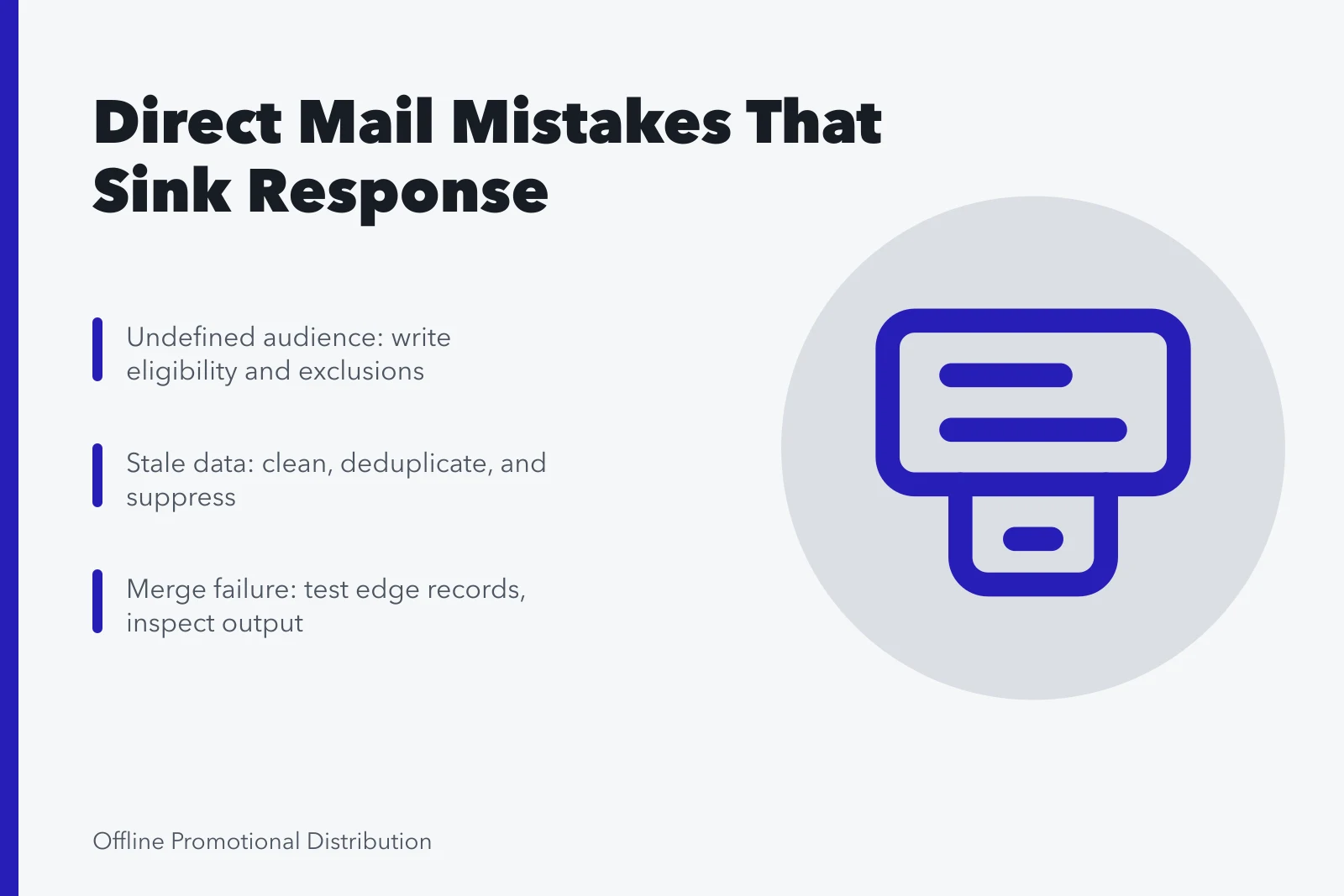
| Undefined audience | Irrelevant contact and weak evidence | Write eligibility and exclusions |
| Stale or duplicate data | Nondelivery and repeated contact | Clean, deduplicate, and suppress |
| Hidden material term | Misleading impression | Place it clearly beside the offer |
| Merge failure | Wrong or exposed personalization | Test edge records and inspect output |
| Nonmachinable surprise | Delay or added cost | Review final physical specification |
| Broken destination | Lost response and mistrust | Test and monitor every route |
| No capacity plan | Poor service after response | Release in supported waves |
| Attributed equals incremental | Overstated impact | Use a credible comparison |
The USPS Domestic Mail Manual (DMM) covers physical standards in DMM 101.1.0 for mailpieces and DMM 201.1.0 for mail. Review the current sections that apply to your piece and get qualified postal support rather than assuming a printer preset is sufficient.
Direct Mail Defects and Repairs
Mistake
- Undefined audience
- Irrelevant contact
- Stale or duplicate data
- Nondelivery, repeated contact
- Hidden material term
- Misleading impression
- Merge failure
- Wrong or exposed personalization
- Nonmachinable surprise
- Delay or added cost
- Broken destination
- Lost response and mistrust
- No capacity plan
- Poor service after response
- Attributed equals incremental
- Overstated impact
Likely harm
- Undefined audience
- Write eligibility and exclusions
- Stale or duplicate data
- Clean, deduplicate, suppress
- Hidden material term
- Place clearly beside offer
- Merge failure
- Test edge records, inspect output
- Nonmachinable surprise
- Review final physical specification
- Broken destination
- Test and monitor every route
- No capacity plan
- Release in supported waves
- Attributed equals incremental
- Use a credible comparison
Repair
- Undefined audience
- Stale or duplicate data
- Hidden material term
- Merge failure
- Nonmachinable surprise
- Broken destination
- No capacity plan
- Attributed equals incremental
Correct misleading offer design
The FTC's Guides Against bait advertising, 16 CFR Part 238, address practices involving advertised products and offers in their defined U.S. legal context. Teams should have qualified reviewers assess the complete current offer, substantiation, terms, availability, and presentation before mailing. Teams comparing formats can study direct mail marketing examples before committing to a full production run.
Example: A mailer advertises a free gift with purchase but does not disclose a required shipping charge. The correction places the shipping charge beside the offer, updates the call script and landing page, and sends a notice to recipients who acted on the original mail.
- Stop unreleased production when a material defect is found
- Identify affected data, batches, routes, and recipients
- Correct connected pages, calls, staff scripts, and inventory
- Send a clear correction when appropriate
- Record complaints, outcomes, cost, and prevention
- Destroy or quarantine obsolete physical stock
Do not quietly edit the landing page and leave contradictory mail in circulation. Give service teams the original and corrected terms, a fair remedy route, and an escalation owner. The post-incident review should change the control that failed, not merely add another approval signature.
Record near misses as well as customer-facing errors. A caught defect reveals where the next job could fail, even when no piece entered the mail.
Prove the correction
The GAO data reliability guide treats reliability as fitness for an intended use and requires documented assessment. Use that test for direct mail marketing mistakes; the federal guide does not certify the local data. Documented assessment of local data quality connects directly to the common direct mail marketing questions teams ask about lists and response.
The FTC's FTC advertising substantiation policy, formally the Policy Statement Regarding Advertising Substantiation, 104 F.T.C. 839 (1984), requires a reasonable basis before objective advertising claims are disseminated. Apply it to direct mail performance claims.
For a correction, record the affected mailing, the fix, and the cost, then test whether the same defect can recur.
Common questions
Can a typo justify stopping a mail run?
Yes when it changes a claim, price, date, identity, contact route, instruction, or other material information.
Who should approve postal specifications?
Use qualified current postal and production review, with one business owner retaining release authority.
How can wrong personalization be prevented?
Minimize data, test varied edge records, inspect merged proofs, reconcile batches, and restrict production access.