Strategy
Part of A complete guide to direct mail marketing for 2027 campaigns
How to improve direct mail marketing without inflating the budget
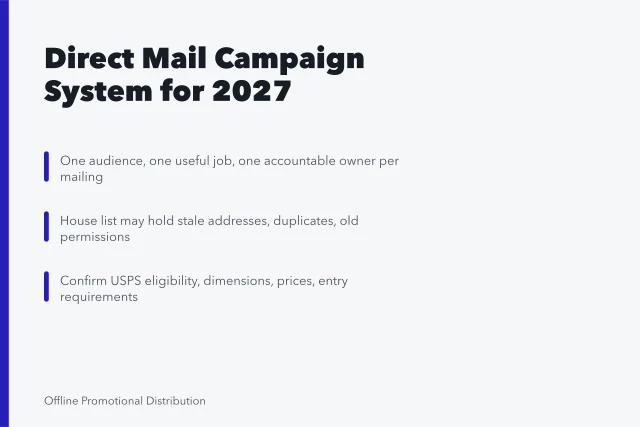
Improving direct mail starts with EDDM route selection, seed records, spoilage reconciliation, and a written stop rule before any print run.
What to take away
- Every Door Direct Mail is priced and accepted by route, so route choice decides both postage and waste.
- Seed records prove what actually landed; without them, accepted volume is a guess.
- Reconcile produced pieces against accepted volume and spoilage before you scale.
- Write the stop rule before the drop, not after the complaints arrive.
- Test one variable on one route before committing a full print run.
Pick the route before the artwork
EDDM pricing and acceptance work by carrier route, not by list. You choose routes, not addresses, so the audience decision happens in the USPS route tool before a designer opens a file.
Route vs List Decision
Route-based (EDDM)
- Unit chosen
- Carrier route
- Tool used
- USPS route tool
- Timing
- Before artwork
- Risk
- Wrong income band
List-based
- Unit chosen
- Address
- Tool used
- List vendor
- Timing
- After artwork
- Risk
- Wrong addresses
That changes the order of work. Pull the route data first, then decide what the piece says to the households on it.
A route with the right household count and the wrong income band is a full-price mailing to the wrong doors. Check household counts, residential versus business mix, and average household size against your offer before you commit.
For a broader view of how route-level decisions fit into a full campaign, a complete guide to direct mail marketing walks through the planning sequence end to end.
Seeds, spoilage and accepted volume
A seed record is a copy mailed to an address you control or a colleague's address. It tells you the drop date, the handling, and whether the piece arrived intact.
Four Numbers to Reconcile
- Records selectedRoute pull
- Pieces producedPrinter count
- Pieces acceptedUSPS acceptance
- Pieces seeded and landedSeed panel
Build a seed panel that covers each route in the buy, not one address for the whole job. Note the date each seed lands.
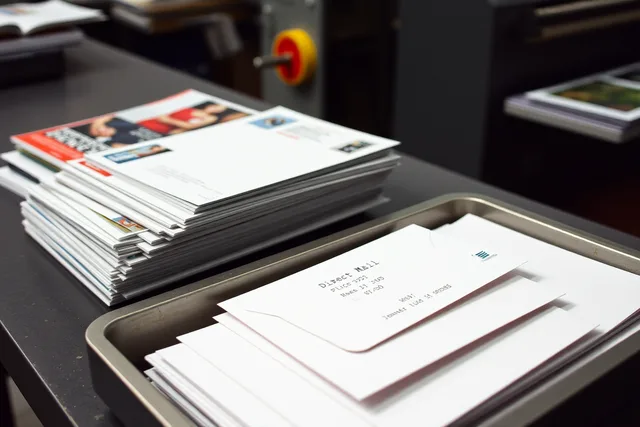
Spoilage is the gap between pieces printed and pieces the postal service accepts. Damaged mail, wrong bundling, missing facing slips and rejected trays all sit in that gap, and none of them reach a door.
Reconcile four numbers after every drop:
| Number | Where it comes from | What a gap means |
|---|---|---|
| Records selected | Route pull | Audience defined |
| Pieces produced | Printer count | Print and bind yield |
| Pieces accepted | USPS acceptance | Spoilage and preparation errors |
| Pieces seeded and landed | Seed panel | Handling and delivery timing |
If produced pieces exceed accepted volume by more than a rounding error, the loss is in preparation, not in the list.
Set the stop rule in writing
A stop rule names the condition that halts the mailing. Write it before the first tray leaves, and give it to the person who can actually stop production.
Written Stop Rule
- Name the condition that halts mailing
- Write it before first tray leaves
- Give it to person who can stop production
- Name the decision owner
- Define evidence needed
- List who they tell
Common stop conditions: seeds not landing inside the expected window, acceptance shortfall beyond a set percentage, a fulfillment queue that cannot absorb the expected response, or a claim in the piece that no longer holds.
Name the person who decides, the evidence they need, and who they tell. A stop rule with no owner is a paragraph, not a control.
Test on one route, then scale
Run a limited batch on one or two routes with a holdout you do not mail. Compare responses and completed outcomes, not raw replies.
Measure completed outcomes after cancellations and returns settle. A reply is not a sale, and a sale that reverses is not a result.
The GOV.UK technology selection guidance is a useful frame for the vendor side of this: adaptable choices, data control, security review, and ownership cost. Apply those questions to your print and data suppliers before the second run.
The CISA software acquisition fact sheet covers supply-chain exposure and vulnerability management. Use it when a mailing depends on a vendor's platform, not as local approval.
Scale only the version that beat the holdout on the outcome you declared first. Write down the rejected options too, because the constraint that ruled them out may change.
Keep the route pull, the acceptance receipt, the seed log and the response file under one set of definitions. A written offline marketing strategy checklist holds those decisions together for the next reviewer.
Common questions
Should a weak mailing get new artwork?
Only after you check the route, the seeds and the acceptance numbers. Artwork rarely explains a shortfall that spoilage or a mismatched route already explains.
What is the fastest useful test?
One route, one changed variable, one holdout, one declared outcome. Keep everything else identical so the result means something.
When should a mailing stop?
When seeds miss the window, acceptance falls short of the threshold you set, fulfillment cannot absorb the response, or a claim in the piece stops being true. The stop rule should already name who decides.
How do I find current EDDM route and preparation rules?
Use the current USPS Every Door Direct Mail guide for route selection, bundling and acceptance.
Route eligibility and preparation details change, so check the live guide before each drop rather than working from a saved copy.
If a question here feels too basic to ask, the direct mail marketing questions nobody wants to ask out loud covers the ones teams usually raise only after something goes wrong.