Strategy
Offline promotional distribution costs by US region: a budget planning guide
Regional cost bands for US flyer, insert, and hand delivery programs, plus the lines that move quotes and the compliance items planners forget.
What to take away
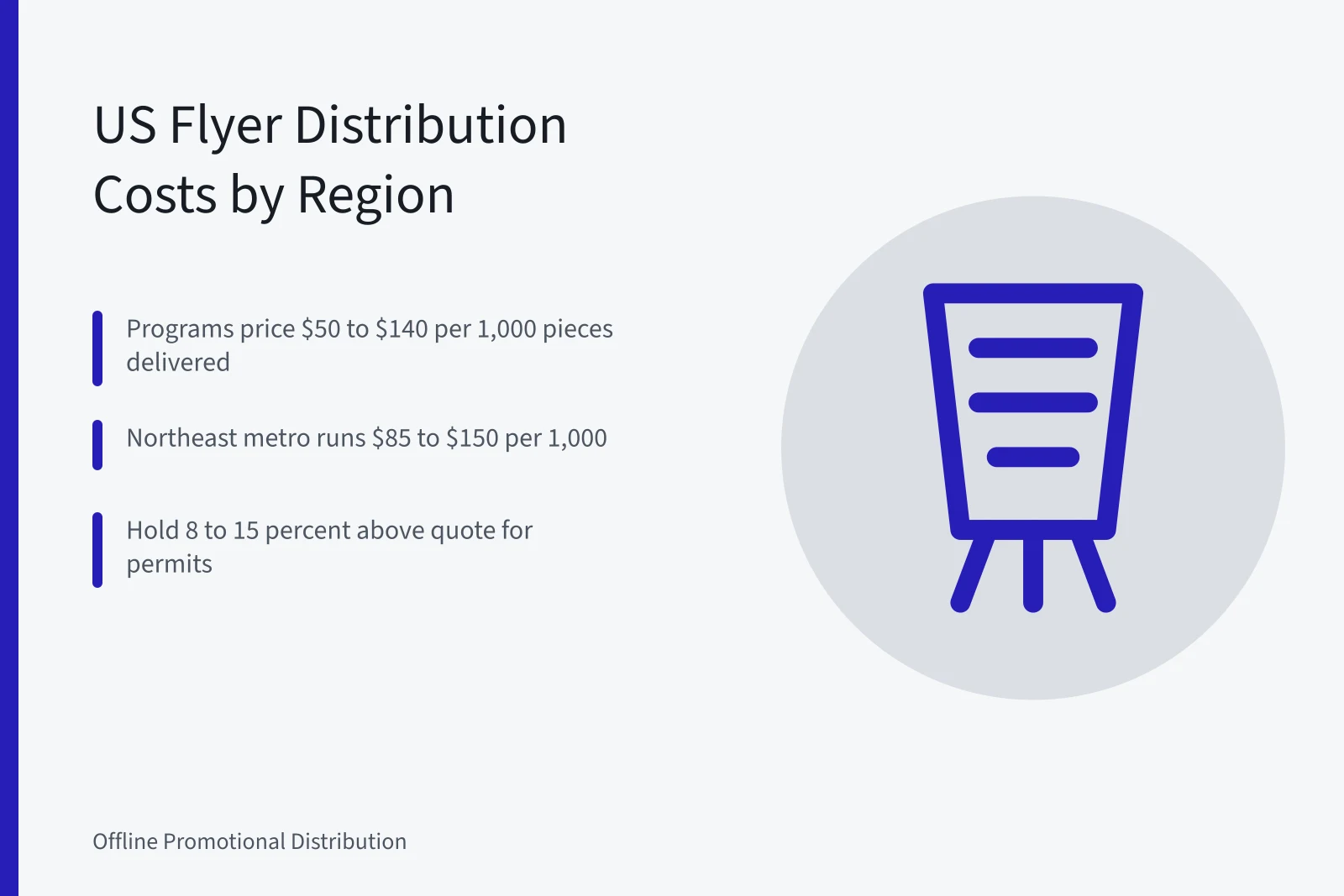
- Typical US flyer distribution programs price between $50 and $140 per thousand pieces delivered, with dense metro cores at the top and bundled rural routes at the bottom.
- Labor and door density move the quote more than printing does once a run passes 10,000 pieces.
- Shared mail inserts usually undercut standalone hand delivery on unit price but give up timing control and neighborhood selection.
- Hold 8 to 15 percent above the quoted rate for permits, compliance review, and response tracking.
Which cost lines make up a distribution budget
Six lines drive every offline drop: printing, addressing or labeling, insertion labor, delivery labor, access or permit fees, and measurement. A single blended rate hides the two lines that scale fastest, which are insertion and delivery labor.
Print pricing follows quantity, not geography. A run split across three regions costs more than one run shipped in three directions. Freight is a small share at typical flyer weights, so it rarely decides a market.
Minimums decide smaller campaigns. Many hand delivery vendors set a 5,000 piece floor per zone, so two small drops in different cities cost more per piece than one larger drop in one city.
Circulation-based programs price differently. Shared mail and newspaper insert programs quote rates against circulation, and those cards vary by market. A large insert in a mid-size daily can cost less per thousand than 10,000 hand-delivered pieces.
Tracking changes the return math. Printing a unique QR code on each piece lets you tie a drop to a landing page, so you can compare response across regions instead of guessing.
Regional cost ranges across the United States
The table gives planning bands for a 10,000 piece single-sheet flyer, print included at a 25,000 run. Quotes move with season, route density, and how much of the work a vendor subcontracts.
Regional cost ranges
| Region | Planning band per 1,000 pieces | Main driver |
|---|---|---|
| Northeast metro | $85 to $150 | Wage floors and permit rules |
| Southeast metro | $55 to $95 | Deeper labor supply, more vendors |
| Midwest metro and small city | $50 to $90 | Shared mail saturation |
| Mountain West | $65 to $115 | Distance between route clusters |
| West Coast metro | $90 to $165 | Labor, print, and access fees |
Northeast and West Coast quotes climb because door-to-door labor carries local wage floors plus payroll burden. Coastal metros also pass through higher insurance and vehicle costs as a per route charge. Rural routes rarely beat metro pricing unless one crew can cover a whole county in a single day.
Events price on a different axis. A booth at a regional trade show rents exhibit space by the square foot, and that one line can exceed the entire flyer budget.
What pushes a quote up or down
- Door density. Apartment towers cut walking time, gated suburbs add it.
- Print run length. Below 10,000 pieces, setup and plates dominate the price.
- Season. October through December tightens both print capacity and labor.
- Access rules. Some cities require a permit or a registered solicitor.
- Sorting. Carrier-route sorted mail earns lower postage but adds preparation time.
A vendor who cannot name which line changed is quoting a market average, not your job. Ask for the split before you compare two bids.
Example: pricing a 10,000 piece flyer drop in three markets
Pricing a 10,000 piece flyer drop
- Collect three quotes per market using one print specification and one quantity.
- Break each quote into print, insertion, delivery, permit, and tracking lines.
- Test a single neighborhood at 2,000 pieces before committing the full run.
- Compare cost per response at 30 days, not cost per piece at signing.
If the test shows 40 cents per response in one market and 95 cents in another, the cheaper piece rate rarely wins the argument. The practical detail is set out in Canada Post Neighbourhood Mail rates what.
A $60 per thousand quote with no tracking tells you less than a $95 quote that reports door counts by route.
Compliance costs planners forget
Promotional items intended for children fall under CPSIA testing and labeling rules, which add per unit cost before the item ships. Advertising claims are reviewed by the FTC under consumer protection law, and a weak substantiation file is expensive to fix later.
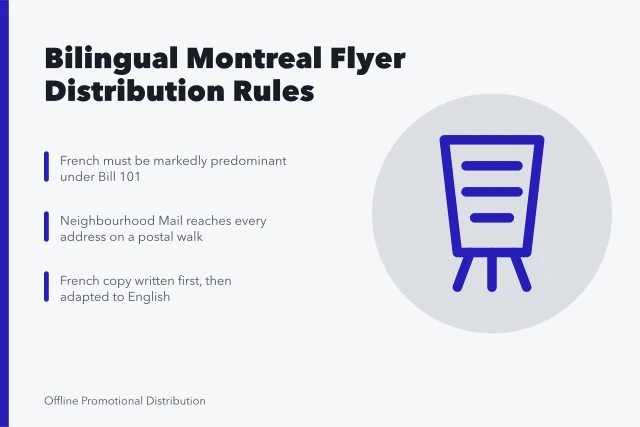
Canada adds its own layers. The Canada Consumer Product Safety Act governs product safety, Canada Post Neighbourhood Mail sets delivery requirements, and Quebec applies language rules to commercial advertising.