Strategy
Offline promotional distribution costs by US region: what budgets should plan for
Regional cost bands, cost per contact math, and sequencing for offline promotional distribution in US metros, plus apparel sourcing and direct mail planning notes.
Offline promotional distribution costs by US region: what budgets should plan for
What to take away
- Regional quotes differ mainly because of labor rates, freight distance, and how dense the drop area is.
- Dense urban cores cost more per piece but produce more contacts per hour of crew time.
- Cost per verified contact is the only fair way to compare a Chicago quote with a Phoenix quote.
- Printed pieces and apparel set the floor of the budget before any distribution vendor is called.
- Shared mail and postal programs stay the most predictable line because published rates govern them.
Why regional quotes move so much
Three inputs set the number: labor, logistics, and density. Labor sets the hourly rate for hand distribution and sampling crews. Logistics sets what it costs to move pallets into a market.
Freight lanes matter more than many planners expect. A Midwest print shop shipping to Ohio, Michigan, and Illinois keeps transit short. Those same pallets sent to the Pacific Northwest add days and dollars.
Outdoor inventory follows the same logic. Billboard rental rates change with location, size, and market, so a downtown bulletin is priced far above a suburban poster (Billboard).
Density then decides how many pieces one worker places per hour. Long suburban driveways slow placement. Apartment corridors speed it up considerably.
Cost bands for flyers, door hangers, and sampling
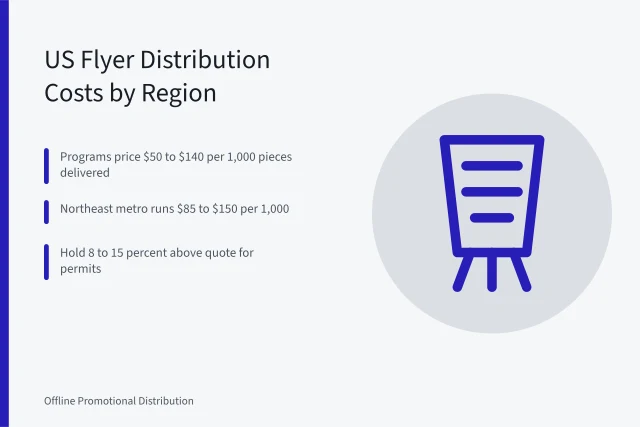
Use the bands below as planning inputs for 2026 budgets, then confirm each with a written quote. Vendors price labor differently, and metro wage floors shift the numbers every year.
| Market type | Placement cost per piece | Main cost driver |
|---|---|---|
| Dense urban core | $0.10 to $0.16 | Parking, building access, security rules |
| Mid-size metro | $0.07 to $0.11 | Local wage floor, routing distance |
| Suburban ring | $0.06 to $0.10 | Fuel, driving time between stops |
| Small town and rural | $0.05 to $0.09 | Travel time per contact |
Print adds roughly $0.02 to $0.06 per piece at 25,000 units. Sampling crews price higher than flyer crews because food handling rules apply.
Cost per contact math you can defend
Follow these steps before you approve any regional budget.
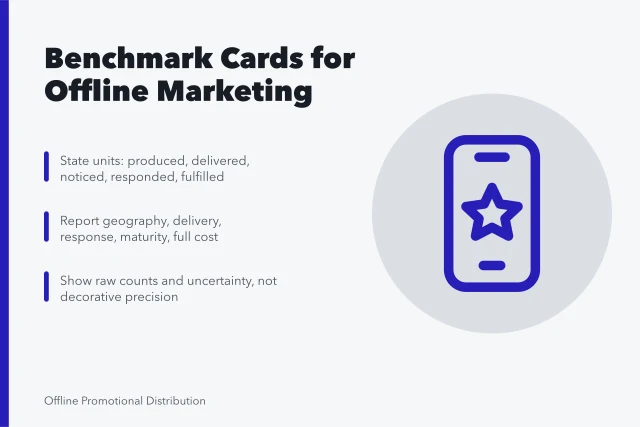
- Count pieces placed, not pieces printed, and ask for GPS or photo verification.
- Attach one tracking tag per market so scans are separated correctly.
- Add print, freight, labor, and apparel into a single total for each market.
- Divide that total by verified contacts and compare markets on that figure alone.
QR codes make step two cheap, because a unique URL per market separates scans with no extra hardware (QR code).
Example: 25,000 flyers across three markets
Illustrative build using the bands above for a three-market Midwest campaign.
- Print25,000 single-sided flyers at $0.04 each, about $1,000.
- Freighttwo pallets on one regional lane, $300 to $500.
- Placement25,000 pieces at a $0.08 average, about $2,000.
- Apparel for six street team membersquoted separately before the crew starts.
- Measurementone QR tag per market, with no added cost.
The distribution total lands near $3,300 to $3,500 before apparel. Trade show space runs on a different model, priced per square foot rather than per piece (trade show).
Apparel sourcing and print runs change the total
Promotional apparel often costs more than the distribution itself, especially when order minimums force over-buying. Digitizing fees, garment blanks, and proofing all sit above the placement line.
For Midwest programs, the Chicago embroidery and screen printing guide covers digitizing, screen print runs, proofing, and freight lanes across state lines. Order garments before booking crews, because production lead times outlast most distribution windows.
Sequencing the campaign before you buy media
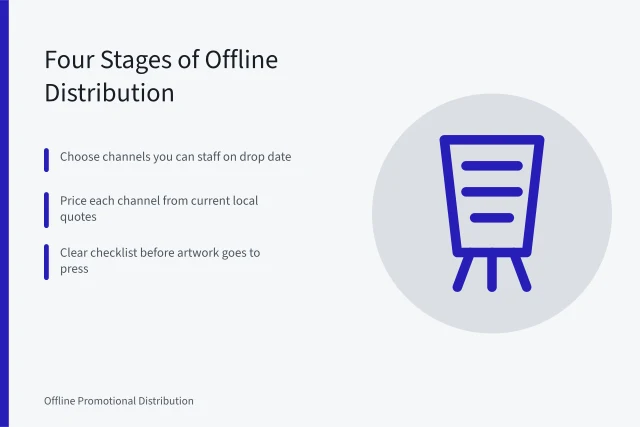
Build the order of operations first, then price each stage.
- Lock the offer and call to action before ordering print.
- Confirm the distribution window and verification method in writing.
- Book apparel production before the crew start date.
- Set one tracking tag per market before launch.
Postal programs run on published rules, so plan them early. Direct mail marketing in 2027 starts with a defined audience, a truthful offer, and production control before fulfillment.
Lead times for garments follow the same pattern, and the Midwest promotional apparel printing resource lists what to reserve first.